David Harrison recently secured a FINRA expungement award on behalf of a registered representative terminated by Wells Fargo Clearing Services, LLC. The firm terminated the broker after a Wells Fargo Bank customer opened and then promptly closed a savings account. That termination created a CRD disclosure that significantly hindered his ability to find new work as a registered representative. David Harrison built the case, presented it to a FINRA arbitration panel, and won expungement of the disclosure. This case is a useful example of a broader pattern. Wells Fargo advisors face distinct challenges when a termination disclosure lands on their CRD record, and understanding why matters for anyone navigating a similar situation.
Why Wells Fargo Wrongful Termination Cases Often Lead to Disputed CRD Disclosures
Wells Fargo operates its brokerage business through two entities, Wells Fargo Advisors and Wells Fargo Clearing Services, LLC. When an advisor is terminated, one of these entities files the Form U5, and its legal and compliance teams choose the language. That language is written to protect the firm, not the departing advisor.
Wells Fargo’s history adds another layer. Following the 2016 “fake account” scandal, the bank operated under intense regulatory scrutiny, and its compliance department adopted a markedly stricter posture toward internal investigations. In that environment, a minor or ambiguous issue can be characterized in stronger terms on a Form U5 than the underlying facts justify.
Large-scale mergers and restructuring at the firm have added further pressure, since terminations sometimes serve broader headcount or risk-management goals rather than reflecting genuine misconduct by the individual advisor.
A few patterns recur in these cases:
- Pretextual firings — a minor, previously overlooked policy issue, becomes the official reason for termination.
- Compliance scapegoating — following an audit or internal investigation, the firm terminates advisors to demonstrate enforcement, even when the advisors followed established procedures.
- Retaliation — an advisor raises a compliance concern and is terminated under an unrelated pretext shortly after.
- Mischaracterized sales practices — ordinary sales or communication practices get relabeled as violations during a post-termination review.
There’s a specific, documented reason Wells Fargo disclosures sometimes don’t hold up to scrutiny. FINRA has sanctioned Wells Fargo in past actions for failing to maintain certain electronic brokerage records in the required ‘write once, read many’ format, a standard designed to prevent records from being altered after they’re created.
When a firm’s systems for preserving documentation are flawed or incomplete, an advisor may find it harder to obtain the documents needed to support their position in an internal review. The result is a disclosure that blames the advisor for a problem the firm’s own compliance infrastructure contributed to. It’s a detail that’s easy to overlook, but it’s directly relevant to building a Rule 2080 case: if the firm can’t produce a complete record, that gap can itself be part of the argument that the disclosure is unreliable.
This isn’t unique to Bakhtiari & Harrison’s client. Other advisors have obtained significant arbitration awards against Wells Fargo in disputes involving termination and disclosure language. None of this means every Wells Fargo termination is unjust. It means the disclosure language deserves scrutiny rather than automatic acceptance.
Wells Fargo Wrote the Story. We’re Here to Rewrite It.
Bakhtiari & Harrison represents financial professionals nationwide in FINRA expungement matters, led by attorneys who helped write the rules governing these cases.
Can I pursue FINRA expungement and a separate wrongful termination claim against Wells Fargo at the same time?
Yes. FINRA expungement only addresses the disclosure on your CRD record. It doesn’t award damages. A separate wrongful termination claim or defamation claim is how you’d pursue monetary damages. Arbitration panels have ordered Wells Fargo to pay damages in addition to ordering expungement in comparable cases.
What Counts as Wrongful Termination in the Securities Industry
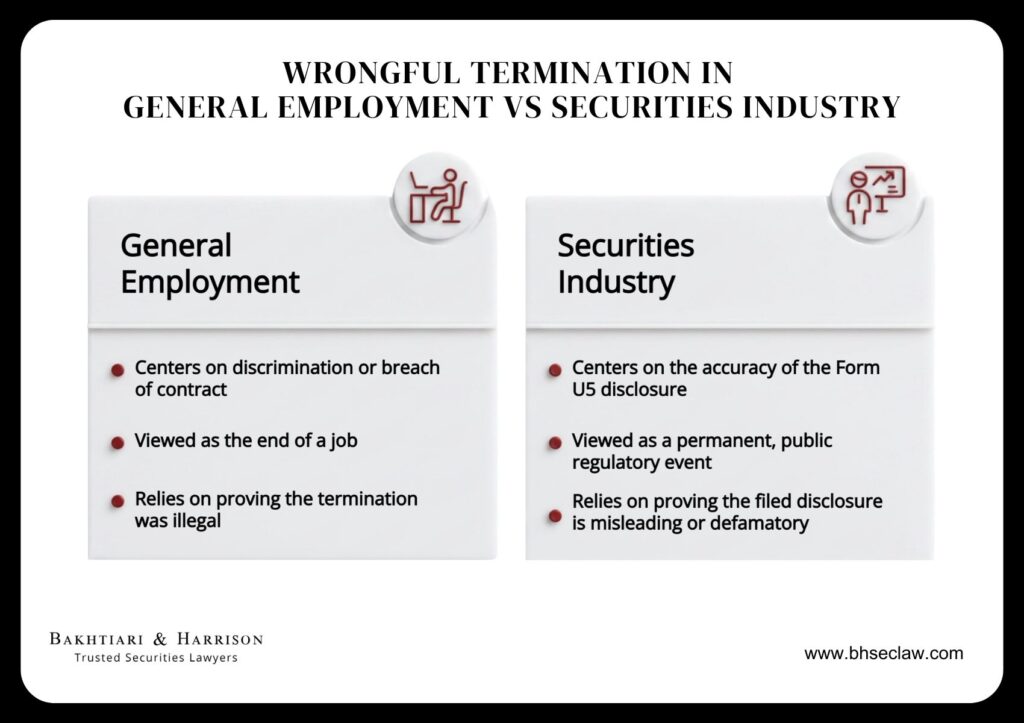
Wrongful termination means something different for a financial advisor than it does in most other professions. Outside the securities industry, the term usually points to discrimination or a breach of contract. For a registered representative, the stakes are higher, and the definition is broader, because a termination isn’t just the end of a job. It’s a permanent, public regulatory event.
A termination becomes legally significant when the reason a firm gives on the Form U5 doesn’t match what actually happened, or when the firm uses its position to create a pretext for dismissal that unfairly damages the advisor’s reputation.
This can look like exaggerating a minor mistake into something that sounds like misconduct. It can also look like using a termination to avoid paying a bonus or severance, or pinning a larger, firm-wide compliance failure on one advisor. If the reason FINRA receives is misleading, defamatory, or factually incorrect, that’s the foundation for a case aimed at expungement, regardless of whether the termination itself was otherwise lawful.
This distinction matters because many advisors assume that if their termination wasn’t illegal, they have no recourse. That’s not how expungement works. The question isn’t whether the firm had the right to terminate you. It’s whether the disclosure it filed about that termination is accurate.
The Three Grounds for FINRA Expungement
A FINRA arbitration panel can only grant expungement when a disclosure meets one of three standards under FINRA Rule 2080:
- The claim, allegation, or information is factually impossible or clearly erroneous.
- The registered person was not involved in the alleged investment-related sales practice violation, forgery, theft, misappropriation, or conversion of funds.
- The claim, allegation, or information is false.
In wrongful-termination cases, the disclosure most often falls under the third standard: language that mischaracterizes what actually happened, often in a way the firm’s own internal review didn’t fully support.
The case above is a good example: the underlying conduct, a customer opening and closing a savings account, simply didn’t support the negative characterization Wells Fargo placed on the broker’s CRD record. That gap between what actually happened and what the disclosure said is exactly what an expungement case has to prove.
What if Wells Fargo opposes my expungement request?
Opposition from a former employer is common in these cases and isn’t a barrier to success. A well-documented case, including performance records and correspondence, can succeed even when the firm actively contests it.
How the FINRA Code of Arbitration Procedure Governs Your Case
Securing an expungement award starts with filing a Statement of Claim with FINRA Dispute Resolution Services under the FINRA Code of Arbitration Procedure, naming the former firm as respondent and laying out the factual basis for why the disclosure meets one of the three Rule 2080 standards.
Under FINRA’s current rules, every straight-in expungement request goes before a mandatory three-arbitrator panel of specially trained arbitrators. Neither side can strike or select panel members, and the panel must reach a unanimous decision to grant expungement. The full process, from filing the Statement of Claim to a final court order, typically takes 9 to 18 months.
At the hearing, the advisor presents testimony and documentary evidence, such as performance records and correspondence, to support the case, and counsel cross-examines any witnesses the firm presents.
A favorable award isn’t the final step, though. Under Rule 2080, the advisor still has to obtain a court order confirming the arbitration award before FINRA will act on it. Bakhtiari & Harrison handles that confirmation step as part of the representation, so the case doesn’t stall out after a win at the hearing. Once the disclosure is removed from the CRD, it disappears from BrokerCheck as well.
How long do I have to file for expungement after a Wells Fargo termination?
FINRA imposes a three-year filing deadline for expungement requests, running from the close of the underlying proceeding. Missing this deadline can permanently close the door on expungement. Given how fact-specific this calculation can be, it’s worth confirming your exact deadline with an attorney rather than calculating it yourself.
Talk to a FINRA Expungement Attorney About Your Case
If you’re a former Wells Fargo advisor, dealing with a disputed CRD disclosure, the first step is a consultation with experienced counsel who handles FINRA expungement regularly. Bakhtiari & Harrison evaluates the specific facts of your termination, the language on your Form U5, and whether your case meets one of the three Rule 2080 standards.
Bakhtiari & Harrison also represents financial professionals in FINRA expungement for customer dispute matters, U5 defamation, employment disputes, and compensation disputes. For a full overview of the firm’s practice, visit the Registered Persons page.
Contact us to discuss your situation.