
For financial services professionals, maintaining an accurate and clean profile on the Central Registration Depository (CRD) is not just about professional pride—it is the bedrock of career mobility and regulatory compliance. However, the securities industry is unique in its public disclosure requirements. Every customer complaint, firm investigation, and termination event is documented on Forms U4 and U5, creating a digital footprint that often follows a broker throughout their career.
When a disclosure is inaccurate, misleading, or malicious, the path to clearing your record is complex and highly procedural. At Bakhtiari & Harrison, we frequently consult with advisors who find themselves unfairly branded by a former employer. Understanding the legal distinction between a customer dispute (Rule 2080) and a firm-initiated “black mark” is vital for any professional seeking intra-industry expungement.
For many professionals, achieving intra-industry expungement is crucial for career advancement and reputation management.
Understanding the Dual Paths of FINRA Expungement
To clear a record effectively, one must first identify the source of the damaging information. FINRA treats disclosures originating from public customers differently from those stemming from internal firm actions or employment disputes.
Understanding how to apply for intra-industry expungement can save time and resources.
The Customer Dispute Framework (Rule 2080)
Rule 2080 is the “gatekeeper” for removing customer-initiated complaints or arbitrations. Because this information is deemed essential for investor protection, FINRA sets a high bar for its removal. Under Rule 2080, an arbitrator must make one of three narrow affirmative findings: the claim was factually impossible or clearly erroneous, the registered person was not involved in the alleged misconduct, or the claim was false.
The Industry-Only Path (Rule 13805) 
When a disclosure does not involve a customer—such as an internal firm review or a disparaging termination comment—it is categorized as a FINRA intraindustry expungement. These cases follow the Industry Code of Arbitration Procedure. While the goal is the same—cleaning the CRD record—the legal standard for success is distinct and often more flexible than the rigid “false or impossible” findings required for customer cases.
Firms often misunderstand the process of intra-industry expungement, leading to disputes.
Defining the “Defamatory in Nature” Standard
The most significant tactical advantage in an intra-industry dispute is the finding that a statement is “defamatory in nature”. This is a specialized regulatory tool that differs significantly from a traditional defamation lawsuit brought in state or federal court.
Intra-industry expungement allows the removal of damaging statements deemed unfair.
TACTICAL EXECUTION: THE EXPUNGEMENT OF FORM U4 AND FORM U5 RECORDS
Clearing a record requires more than just a favorable ruling; it requires a precisely drafted award that FINRA’s Registration and Disclosure department can actually execute.
The process of intra-industry expungement requires careful documentation and legal representation.
Addressing the Reason for Termination
On a CRD, firms must provide a reason for termination, such as “Discharged” or “Permitted to Resign”. If a broker wins relief based on the defamatory nature of the filing, the award must address both the reason and the accompanying “termination comment”. Changing a status from “Discharged” to “Voluntary” is often the cleanest path, as it removes the regulatory requirement for a narrative explanation entirely.
Successfully obtaining an intra-industry expungement requires addressing the reasons for the termination.
The Requirement for Replacement Language
FINRA cannot simply delete a mandatory field on the Form U5; the system requires data to maintain a complete record. Therefore, an arbitration panel cannot just strike a comment; they must provide specific language to replace it. At Bakhtiari & Harrison, we work closely with our clients to draft proposed language that is neutral, accurate, and professional.
Clients often seek intra-industry expungement when facing unjust remarks in their records.
The Scope: Expungement of Form U4 & Form U5 Information
It is a common misconception that a panel can “delete” an entire Form U4 and Form U5. These forms are historical records of registration. Instead, the panel directs the removal of specific defamatory comments or the correction of specific boxes within the form. The award must be specific enough to avoid being “too broad,” which could cause FINRA to reject the filing.
Intra-industry expungement procedures can vary significantly based on the circumstances of the case.
Navigating the Procedural Rules (13805 vs. 2080) 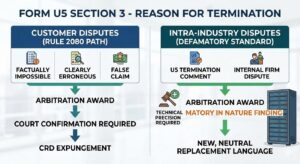
The procedural landscape for expungement underwent significant shifts in late 2023 and early 2026. These updates changed who hears your case and how long you have to file it.
Why This Finding is the Gold Standard for Advisors
In a typical customer expungement, a broker must obtain a court order confirming the arbitration award before FINRA will clear the record. However, FINRA policy creates a powerful exception for internal disputes: if an arbitration panel determines that the Form U5 disclosures are based on the defamatory-nature of the information, FINRA will expunge the specific information without a court order.
Understanding the implications of intra-industry expungement is essential for any financial advisor.
The Role of the Special Arbitrator Roster
One of the most significant 2026 enhancements is the use of a Special Arbitrator Roster for customer-related cases. For “straight-in” requests—those filed independently after a case has closed—a panel of three randomly selected public arbitrators with enhanced expungement training must decide the case.
The new rules surrounding intra-industry expungement are designed to protect advisors.
The Necessity of replacement language
FINRA cannot leave a blank space in the CRD system. If a defamatory comment is removed, the award must explicitly state what text should replace it to ensure the record remains “complete” for regulatory purposes.
Advisors must be aware of the intra-industry expungement process to maintain their reputations.
Avoiding Implied Findings
For FINRA to waive its right to oppose an expungement in court (for customer cases), the findings under Rule 2080 cannot be implied. They must be affirmatively documented in the award.
Each case of intra-industry expungement must be handled with tailored strategies for success.
Even with a strong case, proving the defamatory nature of the language can be difficult if the firm can argue their statement was factually true at the time.
Objective vs. Subjective Language
Proving the defamatory nature of comments is key to a successful intra-industry expungement.
Firms that stick to objective, verifiable facts are at lower risk for expungement. Brokers have a higher success rate when firms use broad, subjective, and inflammatory terms without documented evidence.
Strategic Use of Snapshot Reports
A successful claim often relies on showing that the firm used inflammatory, subjective, or misleading language to describe what was actually a routine or non-disciplinary event.
Why Bakhtiari & Harrison is a Leader in FINRA Expungement
The role of intra-industry expungement is critical in restoring professional credibility.
Choosing the right legal representation is the most critical decision in an expungement case. At Bakhtiari & Harrison, we distinguish ourselves through our deep immersion in the FINRA arbitration forum and our specialized focus on the needs of financial professionals.
Bakhtiari & Harrison stands out as a leader in this field because we don’t just “file” for expungement; we litigate for your reputation.
-
Experience: Our partners have decades of experience navigating the nuances of FINRA’s Industry Code.
-
Strategy: We specialize in identifying the specific “defamatory” triggers that allow our clients to bypass the court confirmation process.
Our focus on intra-industry expungement ensures that clients receive the best possible representation.
-
Results: We have successfully cleared records for advisors nationwide, transforming career-ending disclosures into “Voluntary” departures with clean comments.
FREQUENTLY ASKED QUESTIONS
The path to intra-industry expungement involves meticulous preparation and execution.
What convictions are not eligible for FINRA expungement?
Certain disclosure categories are fundamentally ineligible for removal via the FINRA arbitration process. This includes:
Understanding the challenges of intra-industry expungement can empower financial professionals.
-
Criminal Matters: Charges or convictions for any felony and specific misdemeanors involving fraud, bribery, or theft.
-
Civil Judicial Actions: Where a court has enjoined a broker or found violations of investment-related statutes.
-
Regulatory Actions: Findings or penalties imposed by bodies like the SEC, state regulators, or foreign financial authorities.
-
Official Investigations: Ongoing or completed investigations by governmental bodies.
Intra-industry expungement is vital for clearing records and ensuring accurate representation.
What qualifies a record to be expunged?
To qualify, a broker must demonstrate that the information has no meaningful investor protection or regulatory value. For customer disputes, this requires proving the claim was false, factually impossible, or that the broker was not involved. For intra-industry disputes, a finding that the disclosure is “defamatory in nature” is the standard qualification for removal.
How fast can you get your record expunged?
Most arbitrators can review the material and complete the necessary hearings in a single session. While the overall arbitration process can take months, a simplified case or a well-documented expungement of Form U4 or Form U5 disclosures can move efficiently through the forum. If the defamatory standard is met, you bypass the time-consuming court confirmation phase.
What exactly is an “intra-industry” expungement request?
An intra-industry expungement request is a legal claim filed by a financial advisor against a member firm to remove or amend a disclosure on the firm’s regulatory record that did not arise from a customer complaint. These typically involve disputes over “black marks” on a Form U5, such as a firm’s internal review findings or the specific narrative provided for a termination. Because no customer is involved, the case is governed by the FINRA Industry Code of Arbitration Procedure rather than the Customer Code. The goal is to ensure that the central registration depository CRD accurately reflects the broker’s professional history without unfair prejudice.
Knowing how to file for intra-industry expungement can significantly impact an advisor’s career.
How does the “defamatory in nature” standard differ from Rule 2080?
Rule 2080 is the standard for customer disputes and requires a finding that a claim was factually impossible, false, or that the broker was not involved. In contrast, intra-industry cases often rely on proving that a statement made by a firm is “defamatory in nature.” This is a specialized regulatory standard that does not require the broker to prove all the technical elements of a civil defamation lawsuit, such as actual malice or specific monetary damages. Instead, the arbitrator focuses on whether the language is unfairly damaging and lacks a sufficient factual basis to remain on a public record.
Is a court order always required to finalize an intra-industry expungement?
Unlike customer-related expungements, which always require a court of competent jurisdiction to confirm the arbitration award, some intra-industry cases can bypass this step. If an arbitration panel explicitly states in its award that the recommendation for expungement is based on the defamatory-nature of the information, FINRA may waive the court confirmation requirement. This waiver allows the broker to have the information removed from the CRD and BrokerCheck much faster and at a lower cost. However, if the expungement is granted on other grounds, such as “clearly erroneous,” a court order is still mandatory.
Seeking intra-industry expungement is a proactive step towards maintaining a clean professional slate.
What are the specific requirements for an arbitration award to be enforceable by FINRA?
To be successfully executed, an arbitration award must be precise and identify exactly which parts of the regulatory record are to be modified. It must specify the individual’s CRD number, the occurrence number of the disclosure, and the specific Disclosure Reporting Page (DRP) at issue. The award cannot simply order the “deletion” of a termination filing; instead, it must provide the exact reason for termination and any necessary replacement language. If an award is too broad or fails to provide these details, FINRA may reject it, leaving the broker with an unusable ruling.
Can an arbitrator simply delete a Form U5 termination comment?
No, an arbitrator cannot leave a mandatory field on the Form U5 blank because FINRA requires a complete regulatory record. If a panel finds a termination comment to be defamatory, they must either change the termination category to “Voluntary”—which removes the need for a comment—or provide specific text as replacement language. This ensures that the record remains “complete” for other regulators and future employers while removing the damaging material. Brokers should always propose specific, neutral language to the panel during the hearing to ensure the final award is actionable.
Firms are increasingly aware of the importance of intra-industry expungement in safeguarding reputations.
Who hears intra-industry expungement cases under the 2023/2026 rules?
Under the most recent rule enhancements, “straight-in” expungement requests (those filed after a case has closed) must be heard by a three-person panel selected from a Special Arbitrator Roster. These arbitrators are public chair-qualified and have undergone enhanced training specifically regarding the expungement process and its impact on the integrity of the CRD. The new rules require a unanimous decision from all three arbitrators to grant the expungement. This high threshold is designed to ensure that information is removed only when it truly has no regulatory or investor-protection value.
What is the time limit for a broker to file for intra-industry expungement?
Generally, an associated person has up to six years from the date the disclosure was first reported on their CRD record to bring an action for expungement. However, for “straight-in” requests specifically related to customer-type disclosures, the window is much narrower: typically two years after a case closes or three years after the initial reporting. It is highly recommended that brokers address defamatory U5 comments immediately upon discovery. Waiting too long can allow a firm to argue that the broker “acquiesced” to the language or that the evidence needed to prove the defamatory nature of the statement has gone cold.
Each advisor should consider intra-industry expungement as an essential part of their career strategy.
What role does the “Snapshot Report” play in these arbitration hearings?
The CRD Snapshot Report is a comprehensive regulatory document that contains more detail than the public-facing BrokerCheck report. During an expungement hearing, arbitrators use the Snapshot to identify every instance in which the defamatory comment appears throughout the broker’s history. It allows the panel to see the full context of how the firm reported the event and whether it was updated over time. Brokers must often provide a current copy of this report to the panel so the arbitrators can verify the exact occurrence numbers and DRPs they are being asked to clear.
Can a firm and a broker settle an expungement case privately?
While a firm and a broker can reach a settlement regarding the underlying dispute, the expungement itself cannot be “bought” or “contracted” away without a hearing. FINRA Rule 2081 strictly prohibits firms from conditioning a settlement on a party’s agreement not to oppose an expungement request. Even if the firm agrees to the expungement, the broker must still participate in a recorded hearing and present evidence to a neutral panel. The arbitrators are required to review any settlement documents to ensure the integrity of the process wasn’t compromised by prohibited conditions.
Engaging in the intra-industry expungement process can enhance an advisor’s marketability.
What types of records are generally ineligible for expungement?
Expungement is considered an “extraordinary remedy” and is not available for all types of negative information. What convictions are not eligible for expungement? Criminal convictions, particularly those involving felonies or misdemeanors related to fraud, theft, or bribery, are generally ineligible for removal through FINRA arbitration. Similarly, official regulatory actions from the SEC or state authorities, and civil judicial findings of statutory violations, cannot be expunged by an arbitration panel. The forum is primarily reserved for correcting inaccurate or defamatory factual assertions made by firms or customers, not for erasing verified legal or regulatory history.
Financial professionals must understand the nuances of intra-industry expungement to navigate their careers effectively.
How to get a disclosure removed from FINRA?
-
Analyze the Record: Work with a lawyer to review your full CRD record.
Intra-industry expungement can help brokers regain control over their professional narrative.
-
File a Claim: Initiate an intra-industry arbitration against the firm that filed the misleading disclosure.
-
The Hearing: Appear for a recorded hearing session to present evidence of the disclosure’s defamatory nature.
-
The Award: Obtain a signed award with specific Rule 2080 findings or a “defamatory in nature” declaration.
-
Implementation: Submit the final award to FINRA for processing.
Many brokers turn to intra-industry expungement to combat unjust remarks in their records.
PROTECT YOUR FUTURE
Your CRD record is your professional resume. Do not let a defamatory U5 comment from a former employer dictate your future in the securities industry.
Contact Bakhtiari & Harrison today for a confidential consultation. Our team will review your record and determine the most effective strategy to clear your name.
Bakhtiari & Harrison | Advocating for the integrity of the financial professional.
At Bakhtiari & Harrison, we prioritize intra-industry expungement to uphold your professional integrity.
Follow Bakhtiari & Harrison on LinkedIn to stay up to date on FINRA expungement news.