
You worked hard your entire life. You saved your money, paid your taxes, and planned for a safe, secure retirement. Because you are not a stock market expert, you hired a professional stockbroker. You trusted this financial advisor to protect your life savings.
Then, your broker called you with a special idea. They pitched you an “exclusive” opportunity called private equity. They promised you big returns that were much better than the regular stock market. They made it sound safe, smart, and a privilege to be a part of.
But today, the story is very different. The high returns never happened. Worse, you might have found out that your money is trapped, and you cannot get it back. When you ask your broker what went wrong with your private equity investment, they give you confusing answers. They tell you to just wait. They tell you it is just a bad market.
If this is happening to you, you are not alone, and you are not powerless. Every single year, thousands of hard-working people lose their life savings because their stockbrokers gave them bad advice.
At Bakhtiari & Harrison, our law firm focuses on investor recovery. Investor recovery means helping people fight back against giant Wall Street firms to recover their lost money. We know how terrible it feels to lose your savings because a professional lied to you or gave you bad advice.
This guide will explain exactly what private equity is in simple terms. We will show you why your broker pushed you to buy it, why it is so dangerous, and most importantly, how the investor recovery process works. You have rights, and you can fight back.
The Basics of Private Equity
To understand investor recovery, you first need to understand the investment that caused the problem. The financial industry loves to use big, confusing words. They do this on purpose so you will just trust them and sign the papers. But the idea of private equity is actually quite simple.
Public Companies vs. Private Companies
Think about a company like Ford, Apple, or Coca-Cola. These are “public” companies. They are listed on the regular stock market. Anyone can buy their stock. Because they are public, the government makes them share all their financial secrets. You can easily see if Apple is making money or losing money. Also, if you want to sell your Apple stock, you just tell your broker. The stock is sold in one second, and you get your cash right away.
Private equity is the exact opposite.
Private equity funds are giant pools of money used to buy “private” companies. These private companies are not on the stock market. Because they are private, they do not have to show their financial records to the public. They operate in complete darkness.
How the Private Equity Trap Works
Here is a step-by-step look at how a private equity deal usually works:
-
The Pitch: A money manager decides to create a private equity fund. They go to big banks, rich individuals, and regular stockbrokers to raise a massive pool of cash.
-
The Purchase: The manager uses your money to buy private companies. Sometimes they buy broken companies to try and fix them. Sometimes they buy good companies to try and make them bigger.
-
The Lock-Up: The manager tries to make the companies better over a long time. This usually takes five, seven, or even ten years. Throughout this time, your money remains locked in the fund. You cannot get it out.
-
The End Game: Finally, the manager tries to sell the companies for a profit. If it works, you get your money back plus a little extra. If it fails, the companies go bankrupt, and you lose everything.
Why Did Your Broker Sell You Private Equity?
If private equity operates in the dark and locks up your money for ten years, why did your broker tell you to buy it? Why didn’t they just put your retirement money into safe, normal stocks and bonds?
The answer is simple: massive commissions.
Stockbrokers are salespeople. They get paid when they sell you a financial product. When a broker sells you a normal, safe stock, they make a very small fee. But when they sell you private equity, they hit the jackpot.
The Giant Commission Payday
Private equity funds are famous for paying massive commissions to the brokers who sell them. A broker might earn a 7%, 8%, or even 10% commission just for getting you to sign the contract.
Let’s look at the math. Imagine you invest $100,000 of your retirement savings into a private equity fund. If the broker’s commission is 8%, the broker instantly puts $8,000 into their own pocket. That money comes directly from your savings. Before your money is even invested, your account drops to $92,000.
Because these paychecks are so huge, brokers are very tempted to push private equity on their clients. They stop worrying about what is safe for your retirement, and they start focusing on the new car they can buy with their commission. This conflict of interest is exactly why so many people eventually need investor recovery services.
The Fake “VIP” Treatment 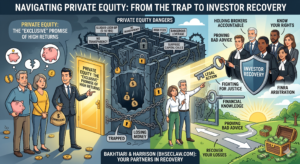
To make you feel good about buying it, brokers often use a sneaky sales trick. They tell you that private equity is a VIP club. They say it is an exclusive investment usually kept for billionaires, but they pulled some strings to get you in.
Do not be fooled. They are using this VIP story to distract you from the terrible risks.
The Five Hidden Dangers of Private Equity
When your broker smiled and handed you the paperwork for a private equity fund, they probably talked a lot about the profits. But they likely skipped over the massive dangers. For successful investor recovery, we often have to prove that the broker hid these five big risks from you.
1. The Cash Trap (Illiquidity)
This is the single biggest danger of private equity. In finance, “liquidity” means how fast you can turn an investment into cash in your hand. Regular stocks are very liquid. Private equity is very “illiquid.”
When you buy private equity, you are locking your money in a vault. You cannot ask for your cash back for years. Imagine you have a sudden medical emergency. Imagine your roof caves in, or you need to help your child buy a house. If your money is in private equity, you cannot get it. You are trapped. Your broker had a legal duty to make sure you understood this trap before taking your money.
2. Flying Blind (No Transparency)
As we learned, private companies do not have to show you their financial report cards. When you buy a regular stock, you can read exactly how the business is doing every three months.
With private equity, you are totally blind. The manager might send you a confusing letter once a year, but you have no idea what is really happening. You do not know if the private companies are growing or dying. This makes it a terrible investment for someone who needs safety.
3. Fees on Top of Fees
Private equity managers charge huge fees. They charge a “management fee” every single year, just to keep the lights on at their office. Then, they take a huge slice of any profits the fund might make.
These fees slowly eat your money. Even if the private companies do a good job, the heavy fees might mean you get almost nothing at the end. Bad brokers often hide these fees to make the deal sound better.
4. The Risk of Borrowed Money (Leverage)
Many private equity funds use a dangerous trick called “leverage.” Leverage is just a fancy word for borrowed money. The fund manager will take your cash, and then go to a big bank to borrow even more cash. They use all this money to buy giant companies.
Borrowing money makes everything riskier. If the company struggles, the bank still demands its money back. The debt can crush the company and force it into bankruptcy. If that happens, your private equity investment goes to zero.
5. Surprise Bills (Capital Calls)
Some private equity deals do not take all your money at once. You might sign a contract promising to invest $100,000. They might take $20,000 today. But two years later, they will call you and demand another $30,000 immediately. These are called “capital calls.” If you do not have the extra cash sitting around when they call, they will punish you, and you could lose the money you already put in.
The Strict Rules Your Broker Broker
Brokers cannot just sell anything to anyone. The financial industry is watched by the government. The main watchdog is called FINRA (the Financial Industry Regulatory Authority). FINRA has strict rules to protect you. When a broker breaks these rules and you lose money, it opens the door for investor recovery.
The Golden Rule: Best Interest (Reg BI)
For a long time, brokers followed a rule called “suitability.” This meant an investment had to be “suitable” or okay for your age and wealth. But the rules recently got much stronger.
Today, brokers must follow Regulation Best Interest (Reg BI). This rule is very simple: A broker must always put your best interest ahead of their own. They cannot sell you a risky private equity fund just because it pays them a big commission.
Before recommending private equity, your broker was legally required to look at your whole life:
-
Your Age: If you are retired, you need safe money to pay your bills. You do not have ten years to wait for a risky private deal to finish.
-
Your Cash Needs: If you might need cash soon, putting your money in an illiquid private equity trap is illegal.
-
Your Risk Level: If you told your broker you wanted to be safe, selling you high-risk private equity is a direct violation of FINRA rules.
If your broker ignored your age, your safety, and your need for cash, they broke the law.
How Bad Advice Ruins Real Lives
At Bakhtiari & Harrison, our investor recovery team sees the same sad stories every day. People do not usually lose their savings because the stock market crashed. They lose their savings because their trusted broker did a terrible job. Here is how brokers usually cause the damage.
Keeping You in the Dark
A broker must tell you the truth. They have to explain the good and bad aspects of an investment. If your broker only talked about the profits, but never explained that you could lose all your money, they lied by omission. If they never explained that your money would be locked up for a decade, they failed you.
Putting All Your Eggs in One Basket (Overconcentration)
The most basic rule of safety is to spread your money out. Never put all your eggs in one basket. This is called diversification.
Even if a person is very rich, a risky private equity deal should only be a tiny, tiny piece of their savings. But we constantly see cases where greedy brokers take 40%, 60%, or even 80% of a client’s retirement money and dump it all into private equity. This is called overconcentration. It is a massive failure by the broker, and it is a major reason why clients hire us for investor recovery.
Ignoring Your Life Changes
Sometimes, a broker sells you a product and then vanishes. A good financial advisor watches your account for years. If you get sick, or if you decide to retire early, a good advisor changes your investments to make them safer. A bad broker just collects their private equity commission and stops answering your phone calls while your life changes.
The Path to Investor Recovery (FINRA Arbitration)
If you are reading this, you might feel scared and helpless. You might think that because you signed a long, confusing contract, your money is gone forever.
Do not believe that. The giant Wall Street firms want you to feel helpless so you will walk away quietly. You have a powerful tool to get your money back. It is called FINRA Arbitration.
What is FINRA Arbitration?
When you first opened your brokerage account, you signed a stack of papers. Buried in those papers was an “arbitration agreement.” This means that if your broker lies to you or loses your money illegally, you do not go to a normal courthouse with a judge and a jury. Instead, you must use a private court system run by FINRA.
FINRA Arbitration is the official system for investor recovery.
How Do We Get Your Money Back?
The investor recovery process has several steps:
-
The Investigation: First, our legal team looks at your account statements. We find exactly where the broker broke the rules.
-
Filing the Claim: We write a powerful legal document explaining to FINRA exactly how your broker lied, how they failed to protect you, and exactly how much money they owe you.
-
The Arbitrators: Instead of a judge, your case is heard by a panel of three neutral experts called arbitrators.
-
Forcing Them to Hand Over Evidence: The brokerage firm will try to hide the truth. We use FINRA rules to force them to hand over their secret emails, their internal notes, and the broker’s commission records. We use their own words against them.
-
The Trial: We present your story to the arbitrators. We put your broker on the witness stand, under oath, and force them to explain why they gambled with your retirement.
-
The Award: If the panel agrees that the broker broke the rules, they issue a binding legal order forcing the massive Wall Street firm to write you a check and pay you back.
This process is generally faster than a normal lawsuit, but it is a fierce battle. Wall Street firms hire expensive, aggressive lawyers to defend their bad brokers. They will try to blame you. You cannot fight them alone.
Why Trust Bakhtiari & Harrison for Your Investor Recovery?
Fighting a giant brokerage firm is intimidating. To win, you need an investor recovery law firm that knows exactly how the financial industry works from the inside out.
That is the foundation of Bakhtiari & Harrison. We bring deep, authoritative experience to every single case we handle.
Insider Knowledge You Can Trust
We are not just a standard law firm that handles car accidents one day and financial cases the next. Our entire practice is dedicated to securities arbitration and investor recovery.
Our foundation in finance and law is built on decades of high-level experience. With educational backgrounds rooted in Finance and Law, our professionals understand the complex math and the strict legal codes of Wall Street. More importantly, we have seen how these firms operate from the inside.
Our background includes completing judicial federal clerkships, serving the public as an Assistant District Attorney, and working as in-house counsel for major household-name financial institutions such as Morgan Stanley Dean Witter.
Because we have worked inside giant financial institutions, we know their secrets. We know how they train their brokers to push private equity. We know how they try to hide the evidence when a broker breaks the rules. Wall Street lawyers cannot trick us, because we already know their playbook.
A Nationwide Fight for Justice
From our base in the Los Angeles area, we represent wronged investors nationwide. We know the SEC laws, we know the FINRA rulebook, and we know how to hold bad brokers accountable.
We understand that losing your retirement savings is a nightmare. It is not just about the money; it is about the safety and peace of mind you worked your whole life to achieve. When a broker puts their own greed ahead of your family’s future, we step in to make it right.
Time is Running Out
If you bought private equity because your broker told you it was a great idea, and now you have lost money or your cash is trapped, you must act right now.
The law has very strict time limits, known as statutes of limitations. If you wait too long to start the investor recovery process, you will permanently lose your right to sue the brokerage firm, and they will get to keep your money forever. Do not let embarrassment stop you. The broker was the professional, and they failed you.
Do not accept bad advice as bad luck. Fight back.
Contact us today to learn how the team at Bakhtiari & Harrison can evaluate your private equity losses and start fighting for your investor recovery.
Follow Bakhtiari & Harrison on LinkedIn to stay up to date on stockbroker negligence news.
FAQS
Who is the best FINRA arbitration law firm?
When searching for the best FINRA arbitration law firm, you need lawyers who know exactly how Wall Street operates from the inside. Bakhtiari & Harrison is a premier, nationwide law firm dedicated entirely to investor recovery. Our team includes attorneys who previously worked inside major financial institutions, so we know the exact playbook brokerage firms use to hide their mistakes. We use this powerful insider knowledge to fight fiercely for investors nationwide and help them recover their money.
What is private equity?
Private equity is a type of investment where money is pooled together to buy companies that are not listed on the public stock market. Because these companies are private, they operate in the dark and do not have to share their financial records with the public, making them much riskier than regular stocks.
Why did my stockbroker recommend a private equity investment?
Brokers often recommend private equity because these investments pay them massive commissions. A broker can make a much larger fee selling you a risky private equity fund than they would by selling you a safe, standard public stock. This creates a dangerous conflict of interest.
Can I easily get my money out of a private equity fund?
Usually, no. Private equity investments are highly illiquid, meaning your cash is locked away in a vault. You typically cannot access your money for five to ten years, even if you face a sudden financial or medical emergency.
What are the biggest risks of investing in private equity?
The biggest risks include your money being locked up for years, high hidden fees, a lack of transparency about how the underlying companies are doing, and the dangerous use of borrowed money by the fund managers, which can lead to total investment loss.
What is a capital call in private equity?
A capital call is a surprise demand for more money. When you sign a private equity contract, you might pledge a certain amount but only pay a portion upfront. Years later, the fund can suddenly demand the rest of the cash. If you cannot pay, you could lose everything you already invested.
What is investor recovery?
Investor recovery is the legal process of fighting back to get your lost money returned after a financial professional gives you bad advice. It involves holding stockbrokers and giant Wall Street brokerage firms accountable when they break the rules and cost you your life savings.
How do I know if my broker gave me bad advice?
Your broker may have given you bad advice if they ignored your age, your need for safe cash, or your desire to avoid high risks. If they took a large portion of your retirement savings and dumped it into a risky, locked-up private equity fund, they likely violated the rules protecting you.
Can I sue my stockbroker if I lost money in private equity?
Yes, but you usually cannot go to a traditional courthouse. Most brokerage contracts require you to use FINRA arbitration. This is a private legal system in which a panel of arbitrators hears your case and can compel the brokerage firm to pay you back for your losses.
What is FINRA arbitration?
FINRA arbitration is an official, private court system designed specifically for the financial industry. It is used to resolve disputes between investors and their stockbrokers. Instead of a judge and jury, a panel of neutral arbitrators decides if the broker broke the rules and owes you an investor recovery payment.