
When a stockbroker’s improper or unsuitable advice has already cost you money, the goal is no longer to vet a future advisor — it is to investigate the one who failed you. That investigation should begin with FINRA BrokerCheck. This guide shows harmed investors exactly how to use BrokerCheck effectively after losses occur, what evidence a report can supply for a recovery claim, and how Bakhtiari & Harrison turns those findings into action. Using BrokerCheck effectively is essential for investors seeking justice.
What Is FINRA BrokerCheck
BrokerCheck is the Financial Industry Regulatory Authority’s free public database of brokers, brokerage firms, and registered investment advisers, along with their reportable history. It draws from the Central Registration Depository (CRD) and the SEC’s Investment Adviser Public Disclosure (IAPD) system. For the full anatomy of a report, see our companion explainer, What Is FINRA BrokerCheck. This article focuses on something different: how to use BrokerCheck effectively after you have already suffered investment losses, and how to convert what you find into a viable claim.
To maximize your chances of a successful recovery, it is crucial to know how to use BrokerCheck effectively in identifying relevant past misconduct.
Why BrokerCheck Matters More After You Have Lost Money
Understanding how to use BrokerCheck effectively allows investors to recognize patterns of behavior that may indicate a broker’s unsuitability.
Most BrokerCheck guides treat the tool as a pre-investment screen. For investors already harmed by unsuitable recommendations, over-concentration, churning, or unauthorized trading, the tool plays a different and arguably more important role.
- It corroborates suspicion. A pattern of prior customer complaints — especially complaints alleging the same misconduct that hurt you — transforms an isolated grievance into evidence of a systemic problem.
- It supports failure-to-supervise claims. A firm that retained or repeatedly hired a representative with multiple disclosures may have breached its supervisory duties under FINRA Rule 3110.
- It strengthens the damages narrative. Restricted Firm designations under FINRA Rule 4111, terminations “after allegations,” and regulatory sanctions are admissible in the context of FINRA arbitration.
- It establishes timing. Disclosure dates can show what the firm knew, and when, before your account suffered losses.
Used this way, BrokerCheck stops being a precautionary tool and becomes the first step of a forensic investigation into your own losses.
Many investors are unaware of how to use BrokerCheck effectively after experiencing significant losses.
How To Use BrokerCheck Effectively as a Harmed Investor 
The standard “five-minute check” is not enough once money is already gone. Below is a longer, claim-oriented workflow that harmed investors should follow.
Investors must learn how to use BrokerCheck effectively to gather evidence for their claims.
Step 1: Pull Both Reports — Broker and Firm
Start at brokercheck.finra.org. Search the individual representative and the brokerage firm separately. A clean broker report at a firm with a long disciplinary tail can still indicate a supervision failure. Save both PDFs the moment you generate them; BrokerCheck content can change as new disclosures are filed or older ones are removed by expungement.
Step 2: Read the Disclosures Section With Your Account in Mind
The Disclosures section is where most claim-relevant facts live. Compare each disclosure to what happened in your account.
By leveraging knowledge on how to use BrokerCheck effectively, investors can better navigate their recovery options.
- Did a prior complaint allege unsuitable recommendations in similar products — variable annuities, non-traded REITs, structured notes, leveraged ETFs, or private placements?
- Did it allege over-concentration, excessive trading, or unauthorized transactions?
- Were there regulatory actions for the same conduct?
- Are there employment terminations after allegations of sales-practice violations?
One matching disclosure raises questions. A pattern of matching disclosures is a roadmap.
Without knowing how to use BrokerCheck effectively, many investors miss critical information that could aid in their claims.
Step 3: Map the Employment History to Your Account Timeline
The Registration History lists every firm where the broker has been registered, with dates. Lay this timeline alongside your account opening date and the dates of the trades or recommendations that caused your losses. Two questions matter most.
- Was the broker registered (and supervised) at the firm during the conduct you are challenging?
- Did the broker move firms shortly before or after your losses — a behavior sometimes used to outrun complaints?
Frequent firm changes, especially among smaller broker-dealers, often correlate with elevated complaint risk.
Step 4: Examine the Firm’s Profile and History
A firm-level BrokerCheck report includes ownership, mergers, and the firm’s own disclosure history — arbitration awards, regulatory actions, and any current Restricted Firm designation under FINRA Rule 4111. Our note on the Rule 8312 amendments explains how Restricted Firm status is now surfaced. A firm with a history of sanctions for supervisory lapses faces an uphill defense when an investor alleges violations of Rule 3110.
This understanding helps investors to effectively use BrokerCheck to their advantage.
Step 5: Cross-Reference Licenses With What Was Sold to You
A broker holding only a Series 6 license generally cannot solicit individual equities. A representative without a Series 65 or 66 cannot lawfully provide investment advice for a fee. If BrokerCheck shows your broker lacked the qualifications to recommend the product that caused your loss, that single fact may support a claim for unauthorized practice or unsuitability.
Recognizing how to use BrokerCheck effectively can make all the difference in your recovery journey.
Step 6: Date-Stamp and Preserve Everything 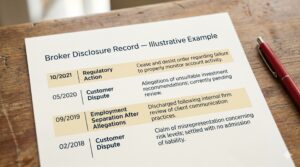
Remember, knowing how to use BrokerCheck effectively is vital to safeguarding your investments.
Print or PDF every report and every page. Note the date and time of access. Disclosures occasionally come off BrokerCheck through expungement under FINRA Rule 2080, so a contemporaneous copy preserves the record you actually relied upon — and that your firm cannot quietly remove later.
Red Flags on BrokerCheck That Support Unsuitable-Advice Claims
The most successful investors learn how to use FINRA BrokerCheck effectively to inform their decisions.
When the question is whether a broker gave improper or unsuitable advice, several BrokerCheck signals carry particular weight in arbitration.
- Multiple customer disputes alleging unsuitability, concentration, or misrepresentation
- Settlements paid by the firm on the broker’s behalf — especially amounts disproportionate to typical account sizes
- Regulatory findings under FINRA Rule 2111 (Suitability) or SEC Regulation Best Interest (Reg BI)
- Internal reviews or terminations “after allegations of” sales-practice misconduct
- Tax liens, bankruptcies, or judgments — relevant not as proof of misconduct but as context for motive in churning or commission-driven cases
- Outside business activities or selling-away that overlap with the products in your account
No single item is dispositive. Together, they often tell a story arbitrators recognize.
Investors must understand the importance of how to use BrokerCheck effectively to enhance their claims.
Limitations of BrokerCheck Every Investor Should Know
Using BrokerCheck effectively also means understanding what it does not show. The database does not capture every complaint; some matters fall below disclosure thresholds, and pending investigations may not yet appear. Expunged events are removed entirely. Unregistered persons and certain insurance-only agents may not be searchable. State regulator records, FINRA’s arbitration awards database, and the SEC’s IAPD often supply additional context. For sophisticated investigations, securities counsel will pull all of these in parallel.
Turning BrokerCheck Findings Into a FINRA Arbitration Claim
Most disputes between investors and broker-dealers are resolved through FINRA Dispute Resolution Services arbitration rather than court. BrokerCheck data feeds that process in concrete ways.
- Statement of Claim drafting. Prior customer disputes alleging the same misconduct can be cited to show notice and pattern.
- Document requests. Firm disclosure history points to compliance reports, Heightened Supervision plans, and Form U4/U5 filings, all of which are worth requesting under the FINRA Discovery Guide.
- Cross-examination at the hearing. A broker’s prior comments or denials about BrokerCheck disclosures can be used to test credibility.
- Damages theories. A clear supervisory record helps frame failure-to-supervise claims under FINRA Rule 3110.
- Settlement leverage. Firms know that arbitrators read BrokerCheck. A poor record often shortens the path to resolution.
When To Call Bakhtiari & Harrison
If your BrokerCheck research has surfaced disclosures that mirror what happened in your account, do not wait. FINRA arbitration claims are subject to eligibility rules. Bakhtiari & Harrison represents investors nationwide in claims involving unsuitable investment recommendations, over-concentration, churning, unauthorized trading, selling-away, Ponzi schemes, and failure to supervise. Our attorneys read BrokerCheck reports the way physicians read charts — and we know which findings convert into recoveries.
Once disclosures are found, knowing how to use BrokerCheck effectively is crucial for building your case.
Frequently Asked Questions
Can I use BrokerCheck effectively after I have already lost money?
Yes. Using BrokerCheck after losses is one of the fastest ways to determine whether your broker has a history of similar misconduct, which can meaningfully strengthen a recovery claim in FINRA arbitration.
What is the most important section of a BrokerCheck report for harmed investors?
The Disclosures section is most important. It identifies prior customer disputes, regulatory actions, employment separations after allegations, and financial events that inform pattern and motive arguments.
Does BrokerCheck show pending complaints?
Some pending complaints appear; others do not. Disclosure thresholds and reporting timing affect what is visible, which is why experienced securities counsel cross-check FINRA arbitration awards and the SEC’s IAPD database.
Can a broker remove negative information from BrokerCheck?
Brokers may seek expungement through FINRA Rule 2080, but expungement has become substantially harder to obtain following recent rule amendments. Many past disclosures remain visible for years.
What should I do if BrokerCheck confirms my suspicions about unsuitable advice?
Save the report, gather your account statements and communications, and consult a securities arbitration attorney. Bakhtiari & Harrison offers confidential consultations to investors evaluating potential claims.
What are red flags on BrokerCheck?
The most significant red flags on BrokerCheck include multiple customer disputes alleging similar misconduct (such as unsuitability, over-concentration, or unauthorized trading), regulatory actions or fines, employment terminations “after allegations” of sales-practice violations, frequent firm-to-firm moves over short periods, settlements paid by the firm on the broker’s behalf, tax liens or bankruptcies, and any current Restricted Firm designation under FINRA Rule 4111. A single red flag may have an innocent explanation, but a pattern of them often signals elevated risk and may support a claim for unsuitable advice or failure to supervise.
Is $500,000 enough to work with a financial advisor?
Yes. Most full-service financial advisors and broker-dealers accept clients with $500,000 in investable assets, and many fee-based registered investment advisers (RIAs) set their minimums at $250,000 or below. The more important question is not whether your account is large enough, but whether the recommendations you receive are suitable for your investment objectives, risk tolerance, time horizon, and liquidity needs under FINRA Rule 2111. Investors with $500,000 portfolios are common targets for unsuitable products such as variable annuities, non-traded REITs, and private placements, which is exactly why a BrokerCheck review before and after losses is critical.
What is the 80/20 rule for financial advisors?
The 80/20 rule (Pareto principle) as applied to financial advisors generally refers to the observation that roughly 80% of an advisor’s revenue comes from 20% of their clients, which can incentivize disproportionate attention to larger accounts and, in some cases, riskier or higher-commission recommendations to grow that top tier. For investors, the practical takeaway is to confirm that recommendations are driven by your suitability profile under FINRA Rule 2111 and Regulation Best Interest — not by the broker’s revenue concentration. BrokerCheck disclosures showing repeated complaints from larger accounts can indicate this dynamic in action.
What is the 5% markup rule?
The 5% markup rule, formally known as the FINRA 5% Policy (originating in NASD’s longstanding guidance and now part of FINRA Rule 2121), provides that markups, markdowns, and commissions on most securities transactions should generally not exceed 5% of the prevailing market price. The rule is a guideline rather than a strict cap — fairness depends on factors including the type of security, transaction size, market conditions, and the broker’s expenses — but markups significantly above 5% can support claims of excessive charges or churning. Investors who suspect they were overcharged should review confirmation statements alongside the broker’s BrokerCheck record for prior complaints involving excessive markups or commission-driven trading.