
If you are a registered representative with a customer complaint on your CRD record, there is one question that tops every other: how long does FINRA expungement take? The honest answer depends on which pathway applies to your situation, how early you begin the process, and whether you have experienced securities counsel guiding each step. At Bakhtiari & Harrison, we have spent decades representing financial professionals in FINRA proceedings, and we know that one of the most damaging misconceptions about expungement is that it is a quick fix. It is not.
The FINRA expungement timeline can impact your career significantly.
The FINRA expungement timeline — from the moment you decide to act to the moment a court confirms your arbitration award and FINRA removes the disclosure from your record — typically spans eight to eighteen months, sometimes longer. Understanding every phase of that timeline is not just helpful. Given FINRA deadlines, it is essential to protect your career and your ability to attract new clients.
Understanding the FINRA expungement timeline is crucial for all registered representatives.
This guide breaks down each stage of the expungement arbitration process, provides realistic timeframes at every step, and explains why the clock may already be running against you.
The FINRA Expungement Timeline, Stage by Stage
Expungement through FINRA arbitration is not a single event. It is a structured, multi-stage process governed by FINRA’s Code of Arbitration Procedure — specifically Rules 12800, 12805, and 13805. Each stage carries its own procedural requirements and its own timing. Missing a step, or misjudging how long a step takes, can delay your case by months or permanently bar you from relief.
Each element of the FINRA expungement timeline serves a purpose.
| STAGE 1 | Pre-Filing Case Evaluation | 2–4 weeks |
|
Before any documents are filed, a thorough pre-filing evaluation forms the foundation of a successful expungement strategy. Your attorney will review the underlying complaint or arbitration, assess which of FINRA’s three legal grounds applies — factual impossibility or clear error, lack of involvement, or falsity of the claim — and determine whether the facts support a credible case for relief. The FINRA expungement timeline starts with a thorough evaluation. This stage also involves identifying the correct procedural route. An associated person named in an active customer arbitration under the customer code requesting expungement must raise the request within that live proceeding, not through a separate filing. If the underlying matter has already closed, the appropriate route is a standalone straight-in request under Rule 13805. Choosing the wrong path wastes critical time. Gathering documentary evidence — trade records, account statements, communications, supervisory logs — begins here as well. |
|
| STAGE 2 | Drafting and Filing the Straight-In Request | 2–4 wks prep + 2–4 wks FINRA processing |
|
Once the pre-filing evaluation is complete, your attorney prepares the formal expungement request. Under Rule 13805, the filing must identify the associated person, specify the disclosure sought for removal, articulate the legal grounds, and include supporting documentation. Proper adherence to the FINRA expungement timeline ensures timely processing. The goal of this entire process is to remove customer dispute information from the Central Registration Depository — the same system that populates the public-facing BrokerCheck profile that clients and employers search before every engagement. That removal happens only at the end of the process, after arbitration and court confirmation, but the quality of the initial filing determines how persuasively the case is framed from day one. FINRA’s administrative processing time after submission typically runs two to four weeks before a case number is assigned. |
|
| STAGE 3 | Arbitrator Selection from the Special Roster | 30–45 days |
|
Under FINRA’s revised rules effective October 16, 2023, all straight-in expungement requests are decided by a panel of three arbitrators drawn exclusively from FINRA’s Special Arbitrator Roster — public, chair-eligible arbitrators who have completed FINRA’s enhanced expungement training and have served through award on at least four customer arbitrations. FINRA randomly selects the panel. Parties cannot stipulate to remove any arbitrator except through a formal challenge for cause — a restriction specifically designed to reduce the influence parties could exercise over arbitrator selection and one that has meaningfully increased the formality of these proceedings. The selection and appointment phase typically takes thirty to forty-five days after the case is accepted. The FINRA expungement timeline is also critical for arbitrator selection. |
|
| STAGE 4 | Customer Notification and Regulatory Notice | 2–4 weeks |
|
Under FINRA’s current rules, the customers whose complaints or arbitrations form the basis of the request must be notified and given the opportunity to participate. State securities regulators are similarly encouraged to appear and object. This reflects FINRA’s intent to balance investor protection against the expungement of customer dispute records that may carry legitimate informational value for the investing public. FINRA handles the notice process, but the possibility of customer or regulator participation introduces a variable that can significantly affect hearing strategy and preparation requirements. Customer notifications during the FINRA expungement timeline are mandatory. |
|
The FINRA expungement timeline includes a pre-hearing conference step.
| STAGE 5 | Pre-Hearing Conference | 4–8 weeks after panel appointment |
| The panel’s chairperson convenes an initial pre-hearing conference, typically conducted by telephone or video. The conference covers the hearing schedule, discovery scope, submission deadlines, and any preliminary procedural questions. For most straight-in expungement cases, discovery is relatively focused — centered on documents and information relevant to the underlying dispute — but the panel retains broad authority to request additional evidence on its own initiative. At this stage, the hearing date is formally set. | |
| STAGE 6 | Discovery and Pre-Hearing Preparation | 60–90 days |
|
The discovery period in FINRA expungement arbitration is narrower than in full customer dispute arbitrations, but it remains substantive. Both sides may request relevant documents, and the panel can direct additional productions. Preparing for the hearing itself — assembling exhibits, preparing witness outlines, drafting pre-hearing memoranda — is where the factual story of your case is shaped. Understanding the FINRA expungement timeline helps in preparation. The quality of this preparation is often the decisive factor. Arbitrators on the Special Roster take their gatekeeping role seriously. A compelling, well-documented factual narrative that clearly meets one of the three recognized legal standards is far more persuasive than testimony alone. |
|
What Happens at the FINRA Expungement Hearing
The evidentiary hearing is where the case is decided. Under FINRA’s current rules, the registered representative must appear — either in person or by video conference, at the panel’s discretion. Failure to appear can result in the request being dismissed.
The hearing phase is vital in the FINRA expungement timeline.
The hearing typically runs one to two days for a straight-in request. Your attorney presents documentary evidence, offers your testimony, and demonstrates through the record that the disclosure meets the applicable standard for removal. If a customer or state regulator appears, opposing arguments will be heard and must be answered.
After the hearing closes, the panel deliberates. For an expungement award to issue, the decision must be unanimous among all three arbitrators. FINRA requires that the written award include specific findings explaining the grounds for the decision and a determination that expungement serves no investor protection or regulatory value. A single dissenting arbitrator defeats the request entirely, regardless of the strength of your case on the merits.
The arbitration award is the next step in the FINRA expungement timeline.
| STAGE 7 | Arbitration Award Issued | Within 30 days of hearing close |
| Under FINRA procedural rules, the panel is required to issue its written award within thirty days of the close of the hearing record. As a practical matter, most expungement awards are issued within two to four weeks. The award either grants or denies the request. If granted, it recommends expungement and identifies the specific CRD disclosures to be removed. But an arbitration award, even one granting expungement, does not, by itself, clear the record. | |
| STAGE 8 | Court Confirmation of the Award | 60–120 days |
|
This is the final — and often underestimated — step in the process. Under FINRA Rule 2080, FINRA will not clear a customer-related CRD disclosure based on an arbitration award alone. A court of competent jurisdiction must first confirm the award by entering an order directing the expungement. Final court confirmation is crucial in the FINRA expungement timeline. FINRA must be named as an additional party in that court proceeding unless FINRA agrees to waive the requirement — a waiver FINRA typically considers when the panel made specific affirmative findings meeting the Rule 2080 standards. Filing the petition, serving FINRA, obtaining the court order, and submitting the confirmed order for processing takes an additional 60 to 120 days in most jurisdictions. Total elapsed time from award to updated CRD record: two to four months. |
|
Why Acting on the FINRA Expungement Timeline Cannot Wait 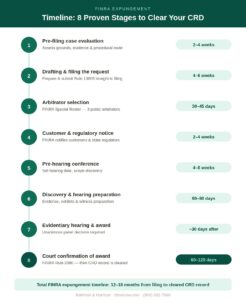
The eight-stage process described above takes eight to eighteen months from initial filing to a cleared CRD record. That reality makes the filing deadlines governing when you can file all the more consequential.
Every stage of the FINRA expungement timeline matters for success.
Under FINRA’s expungement deadlines rules, effective October 16, 2023, brokers have two years from the close of a customer arbitration or civil litigation to file a straight-in request, and three years from the date a written complaint was reported to the CRD. These are not soft deadlines — a missed window ends the inquiry permanently, regardless of how meritless the original complaint was. For a full breakdown of how these time limits work and what time-barred means for your career, see our detailed guide: Master FINRA Expungement Deadlines: 5 Key Facts.
The practical implication is straightforward: given that the process itself takes well over a year, a delay in even beginning the pre-filing evaluation can mean the difference between a clean record and a permanent disclosure. Every day a meritless complaint remains visible on BrokerCheck is a day a prospective client may choose a competitor.
Awareness of the FINRA expungement timeline can prevent delays.
The expungement process under FINRA’s revised rules is more formal, more scrutinized, and more demanding than it was even three years ago. The Special Roster arbitrators bring heightened expectations. Customers and regulators have enhanced rights to participate. The unanimous decision requirement means a single weakness in your case — a gap in the documentary record, an unconvincing factual narrative, or an overlooked procedural step — can defeat an otherwise meritorious claim. The success rate for expungement has declined measurably since the new rules took effect, making experienced counsel not just helpful but essential.
At Bakhtiari & Harrison, our attorneys have handled FINRA proceedings for more than four decades. We understand the procedural architecture governing expungement, from evaluation through court confirmation, and we know how to build the kind of evidentiary record that persuades experienced arbitrators. We represent registered representatives and other financial professionals nationwide — from initial consultation through the final confirmation order that clears your record.
Our firm understands the complexities of the FINRA expungement timeline.
|
Talk to a FINRA Expungement Attorney Today If there is a customer complaint or arbitration on your CRD that should not be there, time is not your ally. Contact Bakhtiari & Harrison for a free consultation. We will assess your eligibility, identify the applicable deadlines, and give you an honest evaluation of your options before that window closes. Follow Bakhtiari & Harrison on LinkedIn to stay up to date on FINRA expungement. (800) 382-7969 | bhseclaw.com/contact/ |
PEOPLE ALSO ASKED
How long does FINRA expungement take?
The FINRA expungement timeline typically spans 12 to 18 months from the date of filing to the moment FINRA updates your CRD record. This includes arbitrator selection, discovery, the evidentiary hearing, the panel award, and a final court confirmation step under FINRA Rule 2080. Complex cases, or those involving customer or regulator opposition, can run longer.
What are the stages of the FINRA expungement process?
The FINRA expungement process has eight stages: (1) pre-filing case evaluation, (2) drafting and filing the straight-in request, (3) arbitrator selection from FINRA’s Special Roster, (4) customer and regulatory notification, (5) pre-hearing conference, (6) discovery and hearing preparation, (7) the evidentiary hearing and arbitration award, and (8) court confirmation of the award. Each stage has its own timing requirements.
What is the deadline to file a FINRA expungement request?
Under FINRA’s rules effective October 16, 2023, brokers have two years from the close of a customer arbitration or civil litigation to file a straight-in expungement request, and three years from the date a written customer complaint was reported to the CRD. Missing these deadlines results in a permanent bar from seeking expungement through FINRA arbitration.
What is a straight-in FINRA expungement request?
A straight-in request is a standalone expungement filing made by a registered representative after the underlying customer arbitration or complaint has already closed. It is governed by Rule 13805 of the FINRA Industry Code and must be decided by a three-person panel from FINRA’s Special Arbitrator Roster. The decision must be unanimous, and the broker must appear at the hearing in person or by video.
What happens at a FINRA expungement hearing?
At the FINRA expungement hearing, the registered representative’s attorney presents documentary evidence and testimony to demonstrate that the disclosure meets one of three legal grounds: factual impossibility or clear error, lack of involvement, or falsity of the claim. Customers and state regulators may also appear and oppose the request. All three panel arbitrators must vote unanimously to grant expungement. The hearing typically runs one to two days.
Does an arbitration award automatically clear my CRD record?
No. In a customer-related matter, under FINRA Rule 2080, a court of competent jurisdiction must confirm the arbitration award before FINRA will remove the disclosure from the CRD. This court confirmation step typically adds 60 to 120 additional days to the process after the award is issued. FINRA must also be named as a party in the court proceeding unless it agrees to waive that requirement.
Can a customer block a FINRA expungement?
A customer can participate in the expungement hearing and present opposition, but cannot unilaterally block the process. FINRA notifies affected customers and gives them the opportunity to appear. If a customer does appear and oppose the request, the arbitration panel weighs that testimony and evidence alongside the broker’s case. Because the panel’s decision must be unanimous, strong customer opposition can influence the outcome even without the power to stop the hearing itself.
Do I need a lawyer for FINRA expungement?
Experienced legal representation is critical. Under FINRA’s 2023 rule changes, expungement requests are decided by specially trained arbitrators who apply rigorous standards, and the decision must be unanimous. Success depends on building a compelling evidentiary record, managing customer and regulatory participation, and navigating the court confirmation process. Brokers who attempt to proceed without experienced FINRA counsel face significantly lower success rates.