You settled the customer complaint years ago because it felt like the fastest way to make the problem disappear. Now that disclosure sits on your BrokerCheck record, and it’s costing you referrals, compliance scrutiny, and sleep. Here’s what most advisors get wrong: they assume FINRA expungement after settlement isn’t possible. It is. FINRA Rule 2081 stops a firm or broker from bargaining for a customer’s silence as part of a settlement deal, but it says nothing about filing a separate expungement request once the dispute is closed.
Yes, You Can Still Seek Expungement After a Settlement
Settling a customer complaint does not waive your right to request expungement. The confusion comes from a single rule that gets misread constantly: FINRA Rule 2081.
What FINRA Rule 2081 Actually Prohibits
Rule 2081 states that no member firm or associated person may condition, or seek to condition, settlement of a customer dispute on the customer’s agreement to consent to, or not oppose, an expungement request. It also bars compensating a customer separately in exchange for that same agreement. FINRA has confirmed this prohibition applies to both oral and written agreements, whether they’re baked into the settlement itself or discussed on the side.
That’s a narrow rule. It targets the bargain, not the remedy. A settlement agreement cannot say “customer agrees not to oppose expungement” in exchange for the payout. It absolutely can be silent on the subject, and the broker can still go file for expungement later on the merits.
Why Settling Doesn’t Waive Your Right to Request Expungement
The distinction that trips people up: conditional expungement offer prohibition versus the underlying right to seek relief. FINRA’s own guidance is direct on this point. According to the FINRA FAQ on Rule 2081, the rule reaches any agreement, at any time, that trades a customer’s non-opposition for a benefit. It does not, however, say a settled complaint is permanently off-limits to expungement.
We see this misconception constantly. An advisor settles, assumes the disclosure is now a permanent fixture on their CRD record, and never files. Years later, they discover a colleague with a nearly identical fact pattern got the same type of complaint expunged, well after the settlement closed.
Settled a Complaint and Want to Know if You Still Qualify?
Bakhtiari & Harrison has recovered clean records for financial professionals nationwide, including in cases that settled years before the expungement request was filed.
Can I still request FINRA expungement if my customer complaint already settled?
Yes. FINRA Rule 2081 only bars conditioning a settlement on the customer’s agreement not to oppose expungement. It does not prevent a broker from filing a standalone expungement request once the underlying dispute has resolved.
Filing a Standalone Expungement Request
Once a customer arbitration or civil litigation has closed, the broker’s path to expungement is what FINRA calls a straight-in expungement request. It’s a separate arbitration claim, filed under FINRA Rule 13805 against the member firm where the broker was associated when the dispute arose. The customer is not named as a party but must be notified and may participate or oppose the request.
How a Straight-In Request Differs From Filing During Arbitration
If the broker sought expungement while the customer’s case was still active, that request falls under Rule 12805, and the customer participates directly. Once the case is settled, the customer often does not participate, though the customer may still appear or oppose the request. That can change the practical presentation of the evidence, and we’ll get into exactly how below.
Filing a straight-in request means preparing a full pleading: the disclosure at issue, the grounds for expungement under Rule 2080, and a certification regarding prior expungement attempts on the same information. Procedural errors can lead to dismissal, rejection, or delay before the panel reaches the merits, so the filing must comply carefully with FINRA’s pleading and certification requirements. We break down the full pleading requirements in our guide to FINRA expungement rules for stockbrokers, which covers the mechanics in more depth than we have room for here.
Timing Windows You Cannot Miss
Deadlines are where a lot of otherwise strong expungement cases die. FINRA Rules 12805 and 13805 set hard limits on when a request can be filed, and missing one means the arbitration forum simply won’t hear the case.
Two Years From the Close of Arbitration or Litigation
If the customer dispute went through arbitration or civil litigation before it settled, the associated person generally must file the straight-in request within two years of the close of that arbitration or litigation. This applies even when the case ended in a settlement rather than an award.
Three Years When There Was No Arbitration or Litigation
Plenty of customer complaints settle before anyone files a formal arbitration or lawsuit. In that scenario, the clock instead runs from when the complaint was first reported to CRD. The broker has three years from that reporting date to file the request for expungement.
The Transitional Deadlines for Older Settled Complaints
Here’s the wrinkle that catches experienced advisors off guard. FINRA’s October 16, 2023 amendments came with transitional rules for complaints that predate the change. Under Rule 13805’s transitional provisions, a broker whose underlying arbitration or litigation closed on or before October 16, 2023, had until October 16, 2025, to file a straight-in request. A complaint reported to CRD before that date, with no associated arbitration or litigation, has until October 16, 2026.
If your complaint settled well before these amendments existed, don’t assume you’re automatically time-barred. Run the actual dates against the rule before writing off your file. We’ve walked clients through this calculation more times than we can count, and the answer is rarely as simple as “too old.” Our FINRA expungement deadlines guide covers the two-year and three-year windows in more detail if you want to double-check your own dates.
How long do I have to file a straight-in FINRA expungement request?
Generally, two years from the close of the customer arbitration or civil litigation, or three years from the date the complaint was reported to CRD if no arbitration or litigation was ever filed. Older cases may fall under separate transitional deadlines.
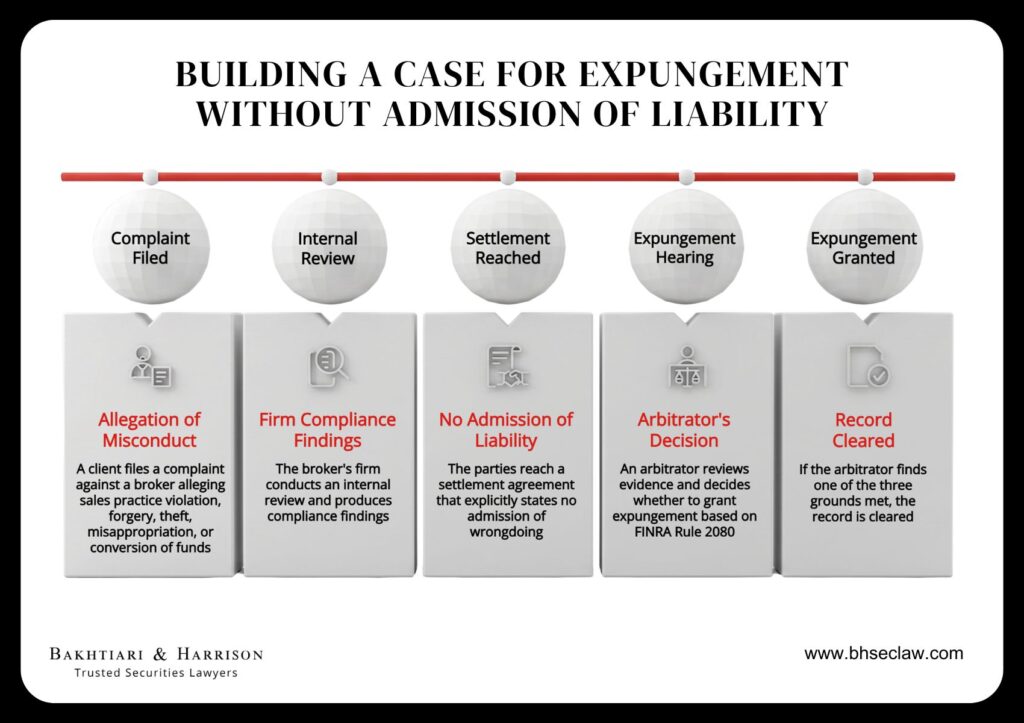
Building Your Case Without an Admission of Liability
Most settlements include boilerplate language stating the payment isn’t an admission of wrongdoing. Advisors often read that as a dead end for expungement evidence. It isn’t. It just means the case has to be built differently.
The Three Narrow Grounds Arbitrators Must Find
An arbitrator can only grant expungement relief on one of three grounds under FINRA Rule 2080:
- Factually impossible or clearly erroneous: the events described could not have happened as alleged, or the record is demonstrably wrong
- Not involved: the broker had no role in the sales practice violation, forgery, theft, misappropriation, or conversion of funds alleged
- False: the claim, allegation, or information itself is untrue
A settlement with no admission of liability doesn’t prove any of these on its own. It’s a starting point, not the argument.
What Evidence Actually Works When the Case Settled
In a settled case, the broker bears the primary burden of proving that one of FINRA’s expungement grounds is met, while the panel independently evaluates the record before granting relief. Strong straight-in cases typically draw on:
- Account records and trade blotters that contradict the timeline or substance of the original allegation
- Firm compliance findings from any internal review conducted at the time of the complaint
- Prior sworn testimony, including On-The-Record statements, addressed proactively rather than left for the panel to discover
- The settlement documents themselves, since arbitrators are required to review the amount paid and the terms of the settlement as part of their analysis
- Client account history showing the broker’s actual role, or lack of one, in the transactions at issue
Vague testimony that the complaint was ‘unfair’ is usually not enough on its own. Specific, documented inconsistencies do.
How Arbitrators Evaluate Credibility in a Settled Case
When the customer doesn’t show up to oppose the request, credibility becomes the whole ballgame. Arbitrators cannot draw a negative inference from the customer’s absence, but an unopposed story still has to hold together on its own weight.
The Panel’s Duty to Review Your Settlement Documents
Under FINRA’s expanded guidance, the panel must review the settlement documents and consider the amount paid, along with any other terms and conditions, before ruling on expungement. Arbitrators are also specifically instructed to ask whether the settlement was conditioned on non-opposition to expungement, which is exactly the Rule 2081 violation discussed above.
This means your settlement agreement isn’t just paperwork sitting in a file somewhere. It becomes part of the record the panel actively weighs.
Why a Consistent Narrative Matters More Than Ever
We’ve written before about the psychological side of expungement hearings, and it applies with extra force here. A broker whose testimony is consistent with the documentary record generally presents a stronger case.
FINRA’s 2023 Rule Changes: Before vs. After October 16
Whether your case settled before or after October 16, 2023, changes more than just your filing deadline. It changes who decides your case and how.
What Changed Under Regulatory Notice 23-12
FINRA’s amendments, detailed in Regulatory Notice 23-12, overhauled straight-in expungement requests. Straight-in cases now go to a three-person Special Arbitrator Roster, made up of public arbitrators who have completed enhanced expungement training. All three must agree unanimously before expungement relief is granted. State securities regulators are notified of every straight-in request and may attend and participate in the hearing.
Cases Settled Before the Amendments
If your customer dispute settled before October 16, 2023, the current straight-in procedures apply if you file now, subject to the transitional filing deadline. The prior straight-in process doesn’t carry over just because the underlying complaint is older. What does carry over is the transitional filing deadline described above, which is the one variable tied to the settlement date rather than the filing date.
Cases Settled After the Amendments
Complaints settled on or after October 16, 2023, fall squarely under the current framework from day one. There’s no grace period and no prior standard to fall back on. The panel composition, the unanimity requirement, and the settlement-review obligations described earlier all apply in full.
Not Sure Which Set of Rules Applies to Your Case?
Bakhtiari & Harrison’s attorneys review the dates, the settlement terms, and the underlying disclosure before we ever file. Request a consultation, and we’ll walk you through exactly where your case stands.
What changed under FINRA’s October 2023 expungement rule amendments?
Regulatory Notice 23-12 introduced strict filing deadlines, required a three-person Special Arbitrator Roster panel with unanimous agreement for straight-in requests, and directed arbitrators to review settlement terms for signs of a prohibited Rule 2081 condition.
What Happens at the Expungement Hearing
An expungement hearing is a recorded proceeding, separate from any hearing on the merits of the underlying complaint that’s already been resolved by settlement. The broker must appear in person or by telephone and give live testimony.
What the Panel Must Do Before Issuing an Award
Before the panel can issue an award containing expungement relief, it must:
- Hold a recorded hearing specifically addressing the appropriateness of expungement
- Review the settlement documents and any payment amounts or conditions tied to the resolution
- Identify which of the three Rule 2080 grounds supports the decision, in writing
- Cite the specific evidence the panel relied on in reaching that conclusion
Even after a favorable award, expungement isn’t automatic. A court of competent jurisdiction still has to confirm the award before FINRA will actually remove the disclosure from CRD and BrokerCheck.
Your Next Step: A Straight-In Case Review
Our firm has spent years focused specifically on securities arbitration and FINRA regulatory matters, including expungement requests filed long after the underlying dispute closed.
We’ve reviewed the settlement language, built the evidentiary record, and stood in front of Special Arbitrator Roster panels arguing exactly the fact pattern described in this article: a broker who settled to move on, only to find the disclosure still following them years later.
If that sounds like your situation, reach out to our FINRA expungement attorneys for a consultation, and we’ll tell you plainly whether your timeline and your facts support a straight-in request.