A customer you barely remember files a complaint two years after the account closed. It gets resolved, the firm pays a small settlement to make it go away, and your name still ends up on BrokerCheck, possibly permanently, for an allegation no one ever proved. That disclosure now sits ahead of every job application, every client pitch, and every compliance review you will face for the rest of your career.
Have a customer complaint on your BrokerCheck record that shouldn’t be there?
Bakhtiari & Harrison offers free, confidential consultations. We’ll tell you whether you qualify for expungement, what it’ll cost, and what we think your chances are, before you commit to anything.
What Is FINRA Expungement?
FINRA expungement is the formal removal of customer dispute information from the Central Registration Depository (CRD), the database behind your public BrokerCheck profile. It applies specifically to customer dispute disclosures and does not remove regulatory actions, criminal matters, or employment terminations.
FINRA treats it as an extraordinary remedy. A panel will only grant it when the customer’s claim meets one of three narrow grounds specified under Rule 2080:
- The claim, allegation, or information is factually impossible or clearly erroneous
- You were not involved in the alleged investment-related misconduct, including forgery, unauthorized trades, misappropriation, or conversion of funds
- The claim, allegation, or information is false
Settling a customer complaint or having a customer withdraw it does not get you here automatically. A panel of arbitrators must still find that one of these grounds applies, and a court must confirm the award before FINRA will actually remove the disclosure. In some cases, FINRA may, in some cases, waive the requirement that it be named as a party in the court confirmation proceeding under Rule 2080, but court confirmation of the arbitration award is still generally required before CRD and BrokerCheck are updated.
Even an unproven, withdrawn, or business-reason settlement can otherwise sit on your record indefinitely. We have seen brokers lose recruiting offers over a single complaint a firm settled purely to avoid litigation costs, with no finding that the broker did anything wrong.
How do I remove a FINRA disclosure?
You file an expungement request, either as part of an active customer arbitration or as a separate straight-in claim, citing Rule 2080 and one of its three narrow grounds. A three-arbitrator panel hears the case, and if it issues a favorable award, a court must confirm it before FINRA removes the disclosure from CRD and BrokerCheck.
Should You Pursue FINRA Expungement?
Deciding whether to file is a real cost-benefit question, not a formality. On one side, a clean record can mean stronger recruiting offers, larger forgivable loans, and a BrokerCheck profile that does not require an explanation to every prospective client. On the other, expungement is not free, fast, or guaranteed.
- Cost. FINRA’s own minimum fees for a straight-in request run several thousand dollars, on top of attorney fees that vary with case complexity. FINRA filing and hearing session fees vary based on claim size, but straight-in expungement requests typically start at several thousand dollars in forum fees alone.
- Time. The process commonly takes 9 to 18 months from filing to CRD removal, including the mandatory court confirmation step.
- Uncertainty. Straight-in requests now require a unanimous decision from a three-arbitrator panel. A single dissenting vote defeats the request, regardless of how strong the underlying facts are.
- One chance. In most cases, you will have only one meaningful opportunity to pursue expungement for a given disclosure. While not an absolute legal bar, a denial or procedural dismissal makes refiling significantly more difficult.
Why this matters with Bakhtiari & Harrison: Ryan Bakhtiari chaired FINRA’s National Arbitration and Mediation Committee, the body that helped shape the very rules now governing your case. (FINRA does not endorse any law firm, and prior committee service does not guarantee an outcome.) We evaluate eligibility, cost, and likelihood of success before you spend a dollar on filing fees.
Get a free, confidential case evaluation →
The FINRA Expungement Process, Step by Step
Once you decide to move forward, expungement follows a defined sequence. We cover the full timeline in detail in our guide to FINRA expungement deadlines, but the core stages are:
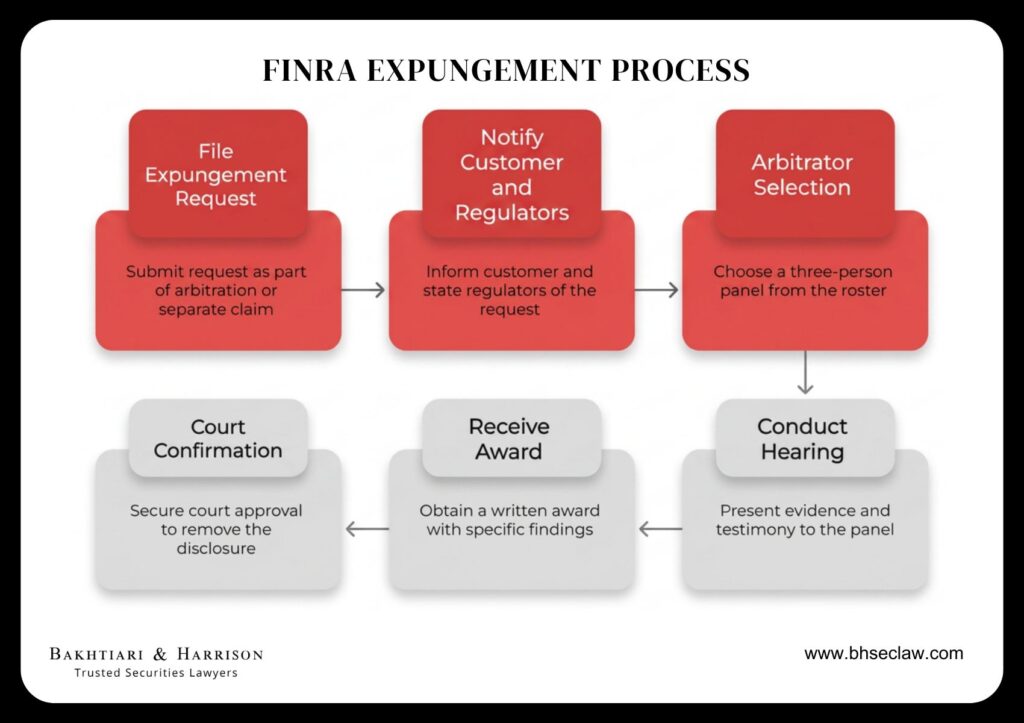
- File the expungement request. This happens either as part of an active customer arbitration or as a separate “straight-in” claim against your former firm after the underlying dispute has closed. The statement of claim must cite the applicable rules, primarily Rule 2080, Rule 12805 for customer disputes, or Rule 13805 for intra-industry disputes, and explain why the disclosure meets one of the three narrow grounds.
- Notice to the customer and regulators. FINRA notifies the customer who filed the original complaint, who has the right to participate in or oppose the hearing. State securities regulators, particularly in states such as California, New York, and Massachusetts, may also receive notice and actively participate or oppose expungement requests.
- Arbitrator selection. Straight-in requests are now decided by a three-person panel drawn from FINRA’s Special Arbitrator Roster, arbitrators with dedicated expungement training. This replaced the older practice of using a single arbitrator for many cases.
- The hearing. You must personally appear, in person or by video. Your attorney presents documentary evidence, witness testimony, and often expert analysis showing the claim was false, impossible, or that you were not involved. The burden is affirmative: it is not enough to show the customer lacked proof; you must present evidence establishing one of the Rule 2080 grounds.
- The award and court confirmation. A favorable award must include specific written findings supporting one of Rule 2080’s three grounds. The award alone does not remove anything. A court must still confirm it before FINRA will act.
Filing deadlines are strict. Under FINRA’s 2023 rule changes, a straight-in request must generally be filed within two years of the close of the related customer arbitration or civil litigation, or within three years of the date a written complaint was reported to CRD if it never went to arbitration. These are eligibility windows under FINRA rules, not traditional statutes of limitation, and arbitrators are instructed to deny late filings without reaching the merits.
What it costs. FINRA’s own minimum fees for a straight-in request total roughly $5,650 in firm-side fees alone, plus hearing session fees that typically add another $2,000 to $4,000. Attorney fees are separate and depend on whether the customer participates and opposes the request. All-in costs for a straightforward, uncontested case typically run $8,000 to $15,000; contested proceedings involving customer participation or complex factual disputes can cost more.
How long does FINRA keep complaints?
Indefinitely. A disclosure stays on your CRD record and public BrokerCheck profile permanently unless it’s expunged. The only exception is if you leave the industry entirely, after which most information drops off BrokerCheck after 10 years, though that exception does not apply if an arbitration award or civil judgment was entered against you.
What Actually Persuades an Arbitration Panel
Most of the public conversation around expungement focuses on the black-letter law: proving factual impossibility, lack of involvement, or falsity under Rule 2080. That legal foundation is necessary, but it is only half of the case. The other half plays out in front of a person who has to decide whether removing information from a public database is the right call.
A FINRA arbitrator is not a judge applying rigid statutory text. Many have experience in or around the securities industry. In our experience, panels respond most to:
- A consistent, credible narrative. Inconsistencies between your testimony and the documentary record are the fastest way to lose a panel’s confidence.
- Corroborating testimony. Witnesses from the firm itself, supervisors, compliance staff, and colleagues carry more weight than your account alone.
- A narrowly tailored request. Arbitrators worry about setting a precedent that opens the door to less deserving cases. A request framed around the specific, unusual facts of your situation is easier to grant than a broad plea for relief.
- Clarity, not volume. A handful of well-organized exhibits that tell a clear story outperforms a document dump every time.
- Customer participation is often outcome-determinative: Expungement requests can become significantly more difficult when the customer appears and contests the request.
None of this guarantees a result. Arbitrators retain discretion, and a single dissenting vote on a three-person panel ends a straight-in request regardless of how the other two see it. But how a case is presented measurably affects whether the legal argument actually lands.
How long do I have to file for FINRA expungement?
Under FINRA’s rules effective October 16, 2023, a straight-in request must generally be filed within two years of the close of the related customer arbitration or litigation, or within three years of the date a written complaint was reported to CRD if it never went to arbitration. These deadlines are strictly enforced.
Why a FINRA Expungement Attorney Matters
Expungement is not paperwork. It is a distinct form of litigation with its own evidentiary burdens, deadlines, and notice requirements, and FINRA’s rules have grown more technical and more stringent over time as the regulator has pushed back against overuse. Attempting it without legal representation commonly leads to procedural errors that can end a case before the panel ever reaches the merits.
A FINRA expungement attorney does work that is easy to underestimate from the outside:
- Assessing whether your specific disclosure actually meets one of Rule 2080’s three grounds before you spend anything on filing fees
- Building the evidentiary record, including trade confirmations, account statements, correspondence, supervisory records, and declarations that establish the factual basis for expungement
- Managing notice to the customer and to FINRA’s Dispute Resolution Services within strict procedural windows
- Preparing you to testify in a way that holds up under cross-examination
- Handling the court confirmation step that actually triggers CRD removal once an award is granted
Because only customer dispute disclosures are eligible under Rule 2080, identifying the exact type of disclosure on your CRD record at the outset is critical to building the correct legal strategy.
Talk to a FINRA Expungement Attorney About Your Record
Most brokers sit on a disclosure like this for months, half hoping it stops mattering, half afraid of what a real answer might be. Neither feeling changes by waiting longer, and every month it stays on BrokerCheck is a month a recruiter, a compliance officer, or a prospective client can see it.
David Harrison has taken on firms the size of Merrill Lynch Pierce Fenner & Smith in expungement proceedings and won. More to the point, for where you are right now, the first conversation with us is free.
You will leave knowing whether your disclosure realistically meets one of Rule 2080’s three grounds, what it will likely cost, and how long it should take, before you commit to anything.
Your CRD record is your professional resume. Contact our FINRA expungement attorneys and find out exactly where you stand.