
The world of finance can often feel like a labyrinth, filled with complex regulations and legal intricacies. For individuals facing disputes with their financial institutions, the Financial Industry Regulatory Authority (FINRA) arbitration process offers a structured way to seek resolution. Understanding what to expect during this form of arbitration is crucial for anyone navigating this alternative dispute resolution process.
FINRA arbitration serves as a vital forum for resolving disputes between broker-dealers and investors outside of traditional court settings. With a unique set of rules and procedures, it allows parties to present their cases before a panel of arbitrators who make binding decisions. However, the journey through FINRA arbitration can be daunting without a clear understanding of each stage, from filing a statement of claim to the final hearing.
In this article, we break down how FINRA arbitration works step-by-step, highlighting key aspects and practical advice. By familiarizing yourself with each phase, you will be better equipped to approach FINRA arbitration with confidence and make informed decisions along the way.
Understanding FINRA Arbitration
FINRA arbitration is a binding dispute resolution process for resolving securities disputes. It is governed by the Code of Arbitration Procedure. This process is often faster than traditional litigation, typically taking 12 to 18 months. This speed is because of an expedited discovery process and fewer pre-trial motions.
FINRA itself is a self-regulatory organization authorized by Congress to oversee the U.S. securities industry, and its Dispute Resolution Services division operates the nation’s largest securities dispute resolution forum for disputes between investors, brokers, and brokerage firms. FINRA arbitration involves several key stages, including pleadings, hearing sessions, and witness testimony under oath. Decisions, called arbitration awards, are made by an arbitration panel and are legally binding without a right to appeal within FINRA. However, limited court review is possible.
Lower-value disputes, involving $50,000 or less, can be settled through simplified FINRA arbitration. In these cases, decisions are based on pleadings and written submissions rather than full hearings.
Here is a helpful breakdown of the FINRA arbitration process:
- Initiation: Filing claims and responses
- Discovery: Expedited exchange of documentary evidence
- Pre-hearing Conferences: Handling preliminary matters
- FINRA Arbitration Hearings: Presenting opening statements and closing arguments
- Final Decision: Issuance of the arbitration award
This process provides an effective alternative to litigation for resolving securities disputes.
Common Disputes Resolved Through FINRA Arbitration
FINRA arbitration covers a wide range of disputes tied to the business activities of a brokerage firm and the individuals who work for it. Understanding the types of claims the forum handles helps investors recognize when arbitration may be the right path.
- Breach of Fiduciary Duty: Claims arising when a broker or advisor fails to act in a client’s best interest, leading to financial losses.
- Suitability: Disputes over investment recommendations that were inappropriate given an investor’s goals, risk tolerance, or financial situation.
- Failure to Supervise: Claims against a brokerage firm for inadequate oversight of its registered representatives.
- Unauthorized or Excessive Trading: Disputes involving trades made without client authorization or churning of an account to generate commissions.
- Misrepresentation and Omission: Claims that a broker misstated or omitted material facts about an investment.
Some securities disputes may also be pursued in court through a class action, but class actions generally proceed outside FINRA arbitration. Investors should evaluate whether an individual FINRA claim, a court action, or another remedy is available.
Is FINRA arbitration worth it?
For most investors and financial professionals bound by a predispute arbitration agreement, FINRA arbitration is worth pursuing because it is typically faster, less expensive, and more private than litigation, with a strong track record of resolving customer disputes through settlement or an award. The advantages of FINRA arbitration are most pronounced in cases with clear documentary evidence and a well-prepared statement of claim.
Customer Disputes vs. Industry Disputes: Rule 12000 and Rule 13000
Not all FINRA arbitration matters follow the same rulebook. FINRA maintains two separate codes of procedure, and knowing which one applies to your case shapes what to expect.
- Code of Arbitration Procedure for Customer Disputes (Rule 12000 Series): Governs disputes between an investor (customer) and a FINRA member firm or one of its associated persons. This is the code most individual investors will encounter.
- Code of Arbitration Procedure for Industry Disputes (Rule 13000 Series): Governs disputes solely between FINRA member firms, or between a member firm and a registered representative — for example, compensation disputes, U5 disclosure disputes, or partnership disagreements between firms.
FINRA member firms are required to arbitrate disputes with customers when the customer requests it and an agreement to arbitrate exists, which is why arbitration clauses appear in nearly every brokerage account agreement. Both codes also include their own expungement provisions, allowing a broker to petition a panel to remove inaccurate or unsubstantiated customer dispute information from their public record, a process our FINRA Expungement Attorneys handle separately from customer-side representation. Because the rules, timelines, and available remedies differ between the two codes, it’s worth confirming which set of FINRA rules applies before your case moves forward.
Overview of the FINRA Arbitration Process
FINRA arbitration is a way to resolve disputes between investors and brokerage firms or financial advisors without going to court. This method uses a neutral arbitrator to make a binding decision. It is faster, less formal, and often more cost-effective than traditional litigation.
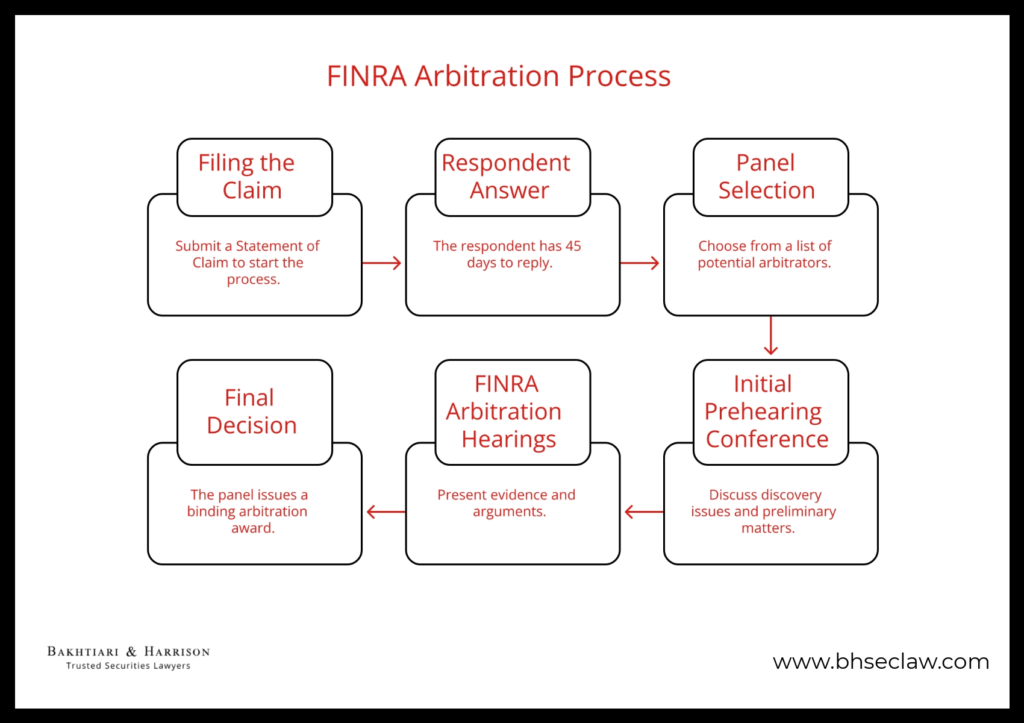
The process begins with filing a Statement of Claim. The respondent must then file an answer within 45 days. A FINRA arbitration panel, comprising one or three arbitrators from FINRA’s roster, reviews the evidence presented. Panel size is governed by claim amount and the applicable rules, not simply the complexity of the dispute. For claims exceeding $100,000, three arbitrators are generally used; smaller claims may be heard by one arbitrator, subject to the rules and party options.
Here’s a quick overview of the process:
- Filing the Claim: Submit a Statement of Claim to start the process.
- Respondent Answer: The respondent has 45 days to reply.
- FINRA Arbitration Panel Selection: Choose from a list of potential arbitrators.
- Initial Prehearing Conference: Discuss discovery issues and preliminary matters.
- FINRA Arbitration Hearings: Present evidence and arguments.
- Final Decision: The panel issues a binding arbitration award.
The process follows the Code of Arbitration Procedure for Customer and Industry Disputes. This ensures a fair and structured resolution. FINRA arbitration offers a simple alternative to traditional litigation, often leading to quicker resolutions.
Filing a Statement of Claim
A FINRA arbitration case starts by filing a Statement of Claim with FINRA. This document includes details of the dispute, parties involved, and the type of relief you seek. Relief can be actual damages, interest, specific performance, or other forms.
Alongside the Statement of Claim, you need to submit a Submission Agreement. This paperwork involves certain filing fees, which vary based on the amount in question. After filing, FINRA will serve the claim to the respondents, who then have 45 days to file an answer.
The entire process follows FINRA’s Code of Arbitration Procedure. This code provides guidelines to ensure a fair FINRA arbitration process.
Key Information to Include in Your Statement
A Statement of Claim must contain all crucial details about the dispute. Here’s what to include:
- Details of the Dispute: Outline all facts surrounding the issue.
- Parties Involved: Ensure you list all relevant individuals and entities correctly.
- Type of Relief Requested: Specify what you are seeking, whether it be damages, interest, or specific performance.
You must also attach a Submission Agreement to the Statement of Claim. Don’t forget to pay the filing fees when submitting these documents. This step is vital for initiating the FINRA arbitration process.
FINRA generally will not accept a claim if more than six years have elapsed from the occurrence or event giving rise to it, subject to the applicable rules. Separate statutes of limitation and other deadlines may also apply.
Can you look up FINRA arbitration cases?
Yes. Final arbitration awards are public and searchable through FINRA’s Arbitration Awards Online database. Hearings themselves and case filings remain confidential, but once a decision is issued, the award becomes part of the public record.
Arbitration Clauses in Brokerage Agreements
Most investors agree to arbitrate future disputes long before a problem ever arises. Brokerage account paperwork typically contains a predispute arbitration clause, a provision stating that any disagreement with the firm will be resolved through FINRA arbitration rather than in court. If a valid arbitration clause covers the dispute, the investor may be required to arbitrate rather than pursue the covered claim in court or before a jury. Whether a particular claim is covered and enforceable depends on the account agreement, the facts, and applicable law.
Arbitration is similar to a court process in that both sides present evidence to a neutral decision-maker, but it typically moves faster and involves fewer procedural formalities. Because these clauses are usually buried in account-opening documents, many investors don’t realize they’ve agreed to arbitrate until a dispute is already underway. Reviewing your account agreement, or having an attorney review it for you, is a useful first step before pursuing any claim.
Prehearing Conferences
Prehearing conferences are vital meetings in the FINRA arbitration process. They help ensure that the proceedings run smoothly and efficiently. During these meetings, parties and arbitrators discuss procedural issues, set deadlines, and address any preliminary matters related to the case. By planning ahead, these conferences aim to streamline the arbitration process and minimize delays.
Purpose and Importance of Prehearing Conferences
The main goal of a prehearing conference is to organize the arbitration process effectively. The initial prehearing conference, often called the Initial Prehearing Conference (IPHC), sets key dates for evidentiary hearings and deadlines for discovery. These conferences are crucial because they lay the groundwork for how the arbitration will proceed. They help manage the process by resolving potential issues early on, thus improving efficiency. As the case progresses, additional prehearing conferences may be needed to handle new issues as they arise. This proactive approach keeps the arbitration moving at a good pace.
What to Expect in a Prehearing Conference
During a prehearing conference, you can expect to discuss many procedural details. An important task is setting a timeline for deadlines on hearings, discovery, and motions. This helps all parties prepare effectively. If the case becomes more complex, further prehearing conferences may be required. These meetings address any ongoing preliminary issues. They allow for issues to be raised and discussed by either the parties or the arbitrator. Before attending the initial prehearing conference, it is helpful if the parties reach agreements on possible matters in advance. This can enhance the efficiency of the arbitration process and save time.
In summary, prehearing conferences play a critical role in the smooth functioning of the arbitration process. They facilitate organized planning, help avoid delays, and ultimately lead to a more efficient resolution of disputes.
Can I appeal if I disagree with the decision?
FINRA does not offer an internal appeals process. Courts will only overturn an arbitration award in narrow circumstances, such as fraud or an arbitrator exceeding their authority, so the decision to arbitrate should be made with that finality in mind.
Discovery Phase
The discovery phase in FINRA arbitration is where parties exchange documents and information to prepare for the hearing. It plays a crucial role in building a case. Unlike traditional litigation, discovery in FINRA arbitration is more limited. This limitation helps streamline the process, saving time and resources. Both parties must cooperate during this phase.
If they don’t, they might face sanctions under the Code of Arbitration Procedure. Discovery requests can be challenged under specific FINRA rules. This gives a structured way to handle disagreements over document production. During discovery, producing party documents is permitted. However, depositions need the arbitration panel’s permission and are limited to rare situations. Subpoenas for non-parties require the panel’s approval through a written request.
Types of Evidence You May Need
In a FINRA arbitration, parties can present various forms of evidence. This includes documentary evidence and expert witness testimony. The rules of evidence here are more relaxed than in court. This means testimony and documents that may not be allowed in court might still be included in arbitration. During the arbitration hearing, both sides can call witnesses and make arguments. Often, affidavits for attorneys’ fees are included. This shows the costs the parties have spent on the dispute. Arbitrations are set up to let all evidence be shown to a neutral decision-maker, similar to a trial but faster and more streamlined.
Importance of Gathering Relevant Documentation
Gathering relevant documentation is key in FINRA arbitration. Both customers and brokerage firms must exchange certain documents. These can include tax returns and trading confirmations, crucial for making a strong case. The right documents can greatly influence the outcome of an arbitration claim. They offer the needed evidence to back up each side’s position. Many attorneys work with Securities Expert Witnesses or FINRA Litigation Consultants during this phase. This helps ensure the case is well-prepared. Document exchange is a vital part of the arbitration process. It helps create informed arguments and ensures a fair hearing. Well-organized documentation can simplify hearing procedures. This minimizes evidentiary objections and makes the process more efficient.
The FINRA Arbitration Hearing
FINRA arbitration hearings are private and focused. Only the parties, their representatives, and the arbitrators attend. This process is an alternative to litigation in traditional courts. It helps resolve securities disputes more quickly, usually within 12 to 18 months.
Structure and Format of the Hearing
FINRA hearings may occur in person, by telephone, or by video conference. The claimant presents their case first. This includes opening statements, witness testimonies, and documentary evidence. Then, the respondent presents their case, and each side delivers a closing statement summarizing the evidence and the relief requested.
The rules of evidence are more relaxed than in court. This allows the process to flow smoothly with fewer interruptions. The arbitration hearing is recorded, and FINRA preserves the recording for review if needed. The panel generally endeavors to issue the award within 30 business days after the record closes.
Role of Arbitrators in the Hearing
Arbitrators are neutral decision-makers. They listen to testimonies and review evidence during the hearing. An arbitration panel typically has one or three arbitrators. These arbitrators come from a list provided by FINRA.
Once selected, they evaluate the arguments and evidence. The panel may award monetary damages and, where authorized, interest, fees, or other relief. Arbitration awards are final and binding. While hearings are confidential, final awards are available through FINRA’s Arbitration Awards Online Database.
Do FINRA arbitrators get paid?
Yes. Arbitrators are independent contractors, not FINRA employees, and are compensated per session through arbitrator honoraria built into the case’s session fees. Their pay is not tied to the outcome of the case.
Understanding Arbitrators’ Selection
When a disagreement arises between investors, brokers, and brokerage firms, arbitration often serves as an effective alternative to litigation. Arbitration is a form of dispute resolution where a neutral third party, known as an arbitrator, makes binding decisions.
The selection process for arbitrators in FINRA arbitration is systematic. Using the Neutral List Selection System (NLSS), parties receive a randomly generated list of potential arbitrators. Each party then ranks and strikes names from this list. This system ensures fairness and gives both parties a say. Once agreed upon, the arbitrators are not FINRA employees. Instead, they are independent contractors from various professions, such as law and finance. They solemnly vow to stay neutral, focusing solely on the evidence before they deliberate and issue a decision.
Criteria for Choosing Arbitrators
FINRA’s Neutral List Selection System (NLSS) ensures that parties in arbitration have a fair choice. This system builds a list of potential arbitrators based on professional qualifications. Parties involved can rank these arbitrators to express their preferences. They can also object to any potential arbitrators. This might be due to personal bias or financial interest, which ensures an unbiased process.
A case might be heard by either a single arbitrator or a panel of three arbitrators. This setup reflects the complexity of the dispute. Despite not being FINRA employees, these arbitrators consistently meet qualification standards. Such standards involve relevant professional experience and specific arbitration training. Because so much rides on this selection process, many claimants rely on an arbitration attorney to help evaluate the candidate list. For a closer look at how this stage can shape a case, see our article on selecting arbitrators in FINRA arbitration.
Qualifications and Experience Needed
For individuals to become FINRA arbitrators, they need a strong professional background. Typically, they include attorneys, accountants, and local business people. This mix ensures they understand securities disputes and can navigate complex situations.
FINRA arbitrators come from a range of professional backgrounds and must satisfy FINRA’s roster, disclosure, training, and eligibility requirements. The chairperson of a three-arbitrator panel must meet additional chairperson-eligibility standards. This keeps their knowledge relevant to current industry standards. Arbitrators should excel in understanding expert witness testimonies and procedural management. The chairperson of an arbitration panel, often tasked with managing procedural aspects, must possess leadership skills.
Although legal representation in these proceedings is not mandatory, it is wise. The arbitration process can be intricate. Brokerage firms often have legal teams, so investors benefit from legal support. This balance helps level the playing field in these disputes.
What’s the difference between arbitration and mediation?
Arbitration results in a binding decision made by a neutral arbitrator or panel. Mediation is non-binding and relies on a mediator helping both sides negotiate their own resolution. Parties can choose mediation before or even during arbitration.
The FINRA DR Portal: Managing Your Case Online
Once a case is underway, most of the day-to-day administration happens through FINRA’s Dispute Resolution Portal (DR Portal). FINRA’s Dispute Resolution Portal is used for many case filings, communications, scheduling activities, and document exchanges.
Through the DR Portal, parties can:
- Submit and review case documents and filings
- View real-time case status and deadlines
- Respond to scheduling polls to set hearing dates
- Communicate with FINRA case administrators and, where appropriate, the opposing party
Case participants receive a registration invitation after a claim is filed and must create a separate DR Portal account. Participants should follow FINRA’s registration instructions and monitor the portal for case communications and deadlines. Because deadlines, hearing dates, and document exchanges are tracked through the portal, keeping on top of it is one of the more practical, if unglamorous, parts of preparing a compelling case. Many claimants ask their arbitration attorney to monitor the portal on their behalf so nothing is missed.
Timeline of the FINRA Arbitration Process
The timeline for FINRA arbitration proceedings typically ranges from 12 to 18 months. This period begins with the initial pleadings and ends with the final arbitration award. Investors asking how long the process will take should expect the answer to vary significantly based on case complexity and whether it qualifies for simplified arbitration.
For disputes involving $50,000 or less, arbitration can be simplified. These simplified arbitrations rely on written submissions instead of full hearings. They usually resolve more quickly. According to FINRA, these cases take around 7.1 months to decide. In contrast, cases with hearings on the merits take about 16.6 months.
A key factor speeding up this process is the expedited discovery. This means there’s less evidence exchanged and fewer disputes compared to traditional litigation. Also, parties give up almost all rights to appeal the decision. This leads to quicker and more final resolutions than those found in the courtroom.
Key Milestones in the FINRA Arbitration Process
- Filing and Initial Pleadings
- The process starts with filing fees and a Statement of Claim that outlines the dispute with the brokerage firm or financial advisor.
- The respondent has 45 days to file an answer.
- Prehearing Conferences
- An Initial Prehearing Conference is scheduled to clarify preliminary issues and set key dates.
- Discovery Process
- Discovery is faster and involves fewer disputes than in litigation.
- Parties exchange necessary documentary evidence.
- Arbitration Hearings or Written Submissions
- For disputes under $50,000, decisions may be made on written submissions only.
- Larger cases involve full arbitration hearings, with opening statements, testimony, and a closing statement from each side.
- Final Award Issuance
- Arbitrators deliberate and issue a decision after reviewing the evidence.
- The arbitration award is final and binding, with limited appeal options.
Using codes specific to customer and industry disputes, FINRA ensures clear guidelines throughout the process. This alternative to litigation allows for efficient outcomes, even for complex financial disputes. Whether engaging a single arbitrator or a panel, parties experience a streamlined process that’s quicker than traditional court cases.
Potential Fees and Costs Incurred
When entering the FINRA arbitration process, budgeting for potential fees and costs is crucial. Costs can vary based on factors like the amount in dispute and whether you’re a customer or a member of a brokerage firm. Here’s a detailed breakdown of what to expect.
Breakdown of Possible Fees
Filing and hearing fees vary according to the amount in dispute, the applicable FINRA code, the type of party, and whether the case proceeds to hearings. FINRA’s current fee schedule or calculator should be consulted before filing.
Session fees are an important consideration in the arbitration process. For smaller disputes, a single arbitrator typically handles the sessions, which incurs a moderate fee. In cases involving larger claims, a panel of three arbitrators may be required, resulting in increased session costs. Moreover, attorneys often advise conducting an initial damages analysis prior to submitting a Statement of Claim. This analysis, which helps clarify potential compensation, can involve a separate expense. Other costs may include member surcharges or process fees, which can vary based on the specifics of each case.
Budgeting for Arbitration Expenses
Preparing for arbitration requires a clear understanding of the potential expenses involved. Initial filing fees can vary significantly depending on whether you are a non-member or a member of the brokerage community. Additionally, it is wise to consider conducting an initial damages analysis. This analysis, typically carried out by a forensic accountant or a securities fraud expert, can provide invaluable insights into the potential compensation you might seek. Allocating resources for these preliminary steps is essential for an informed and strategic approach to the arbitration process.
Legal representation should also be budgeted, as it’s common for brokerage firms to have attorneys present during proceedings. An experienced Securities Expert Witness or a FINRA Expert Consultant can add costs, depending on the complexity and duration.
In summary, understanding the potential fees and associated costs is essential in navigating the FINRA arbitration process effectively.
What are the advantages and disadvantages of FINRA arbitration?
The advantages of FINRA arbitration include a faster timeline, lower cost, and arbitrators with securities industry expertise, all handled through a confidential process. The tradeoffs are limited discovery compared to litigation and virtually no right to appeal once an award is issued, which makes case preparation critical from the outset.
Representing Yourself vs. Hiring Legal Assistance
When you enter a FINRA arbitration, you have two main choices: represent yourself or hire legal assistance. This decision can significantly affect the outcome of your case.
Pros and Cons of Self-Representation
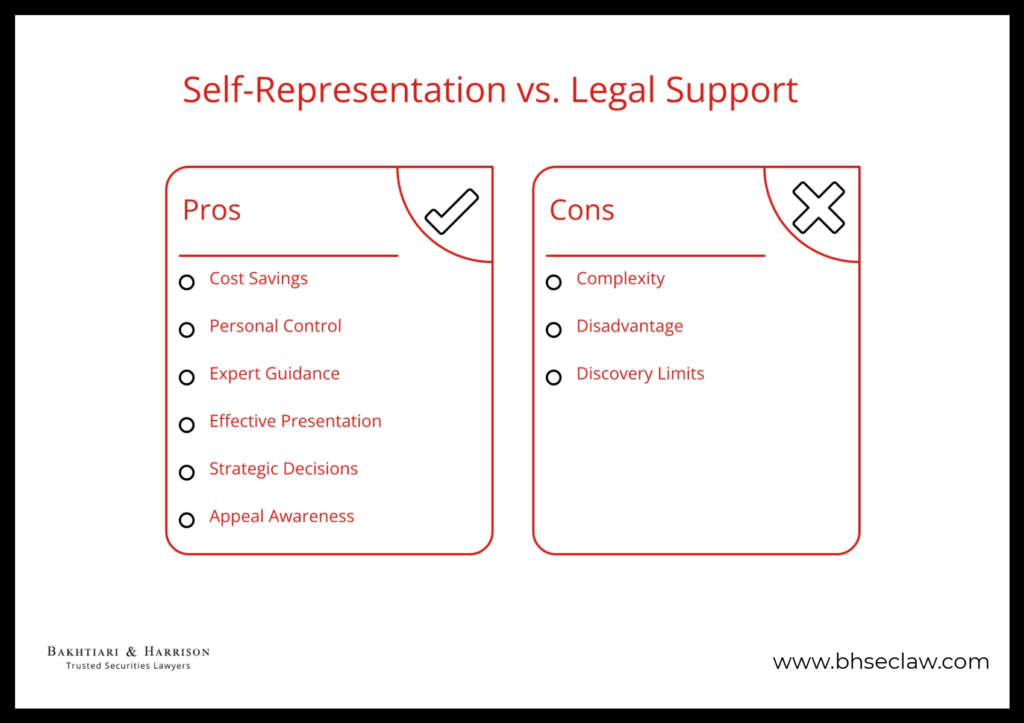
- Pros:
- Cost Savings: Avoiding attorney fees is a major benefit.
- Personal Control: You have full control over your case presentation.
- Cons:
- Complexity: The process can be intricate. Securities arbitration often involves complex rules and procedures rooted in federal securities law.
- Disadvantage: Without legal expertise, you might struggle against Wall Street firms that use professional counsel.
- Discovery Phase: There’s limited discovery in arbitration, which can be a challenge if you need documents from the opposing party.
Benefits of Legal Support
- Expert Guidance:
- An experienced arbitration attorney can help you navigate the complexities of the FINRA arbitration process.
- They ensure you fully understand your rights and responsibilities.
- Effective Case Presentation:
- Attorneys present documentary evidence and expert testimony in a way that builds a compelling case and can strongly influence the arbitration award.
- Strategic Decision-Making:
- Legal advisors help determine whether arbitration or mediation is best, impacting costs and resolution time.
- They guide you in managing risks and costs, such as filing fees and possible attorney charges.
- Awareness of Limited Appeals:
- With limited grounds for appeal, legal help prepares you for final dispute resolution.
In conclusion, while self-representation is an option, the complexities often make hiring legal assistance a more advantageous choice in FINRA arbitration. FINRA provides the procedural framework, but it does not advocate for either side. That role falls to each party’s own counsel. If you’re ready to discuss your situation, our FINRA Attorneys offer free consultations to help investors evaluate their options.
Mediation as a Strategic Alternative
Mediation offers a pathway to resolve disputes that is voluntary and less formal than arbitration or litigation. In this process, a trained mediator helps both parties reach an agreement without imposing a solution. It is non-binding and can be much less costly than arbitration or going to court. This method has a success rate of over 80%, making it an attractive option for those involved in securities disputes.
Parties can choose mediation at any stage during the arbitration process: at the very start of a dispute, or even after arbitration has already begun. This flexibility allows for creative resolutions that formal arbitration or litigation might not offer, and it gives participants a chance to test the strength of their arguments before committing to a full hearing.
| Aspect | Mediation | FINRA Arbitration |
|---|---|---|
| Binding Decision | No, unless both parties agree | Yes |
| Formality | Less formal, flexible | More formal, structured |
| Decision-maker | Parties reach their own agreement | Arbitrator or panel decides |
| Cost | Typically lower | Can be higher |
| Success Rate | Over 80% | — |
Choosing between arbitration and mediation often comes down to how much control you want over the outcome. Mediation keeps that control with the parties; arbitration hands the final decision to a neutral third party. Many attorneys recommend at least considering mediation before committing to the time and expense of a full arbitration hearing, since it costs little to explore and can resolve a dispute without ever reaching a hearing.
Outcomes of the Arbitration
In 2024, 84% of customer arbitration cases with FINRA closed through settlement or paid damages. This high resolution rate shows the effectiveness of the arbitration process. The average duration for cases that proceed to a hearing is about 16 months. This is faster than traditional litigation.
Arbitration awards are typically issued within 30 days after the hearing. These awards are legally binding for both parties. There are limited options to appeal these awards. Courts rarely overturn them, providing a level of finality not commonly found in court litigation.
FINRA administers the arbitration forum but does not itself convert an award into a court judgment. A party may seek court confirmation and enforcement of the award. FINRA rules may also permit regulatory action against a member firm or associated person that fails to comply with an award or settlement.
What to Expect After the Hearing
After the hearing, arbitrators deliberate and issue a decision, usually within 30 days. The decision, known as an arbitration award, is legally binding. FINRA does not provide an internal appeal process for these awards.
Although arbitration awards can be reviewed by the court in limited situations, they are usually upheld. The entire FINRA arbitration process takes about 16 months from start to finish for cases that don’t settle early. Unlike courtroom litigation, FINRA arbitration proceedings are generally private, although awards are publicly available through FINRA’s Arbitration Awards Online database, and related documents may become public in court or regulatory proceedings.
What Happens If the Respondent Firm Fails to Pay
Winning an arbitration award is not always the end of the story. If a respondent firm or broker disagrees with the decision or simply refuses to pay, the winning party generally must go to court to have the award confirmed, at which point it becomes enforceable like any other legal judgment.
FINRA rules also allow for suspension of a firm’s or individual’s FINRA membership for failing to pay an arbitration award, which is a significant point of leverage for claimants. If you’ve won an award and are having trouble collecting, our guide on getting paid after winning FINRA arbitration walks through the enforcement steps.
The privacy and efficiency make FINRA arbitration an attractive alternative to traditional courtroom proceedings.
Considering FINRA Arbitration? Speak With Our Securities Attorneys
At Bakhtiari & Harrison, we represent claimants in FINRA arbitration, providing the experience and strategic counsel required to navigate the complexities of financial disputes. Our AV-rated law firm assists investors, brokerage firms, and financial advisors throughout the arbitration process, from filing a statement of claim through enforcement of a final award.
Our attorneys have deep experience across securities, employment, and regulatory matters, and we work with clients nationwide to build the strongest possible case for their circumstances. If you have a dispute related to securities or investment activities, contact us today for a free consultation.