Securities arbitration is a common way investors resolve disputes with FINRA-member brokerage firms and their registered representatives. If your account agreement contains an enforceable predispute arbitration clause and FINRA has jurisdiction, arbitration may be the required forum. Here’s what that actually means for you, broken into plain steps instead of legal jargon.
In this guide, you’ll find:
- What securities arbitration is and how it’s different from a lawsuit
- All 7 stages of the FINRA arbitration process, explained one by one
- A pre-filing checklist so you know if your case still qualifies
- What it actually costs, beyond the filing fee
- Whether you can appeal if you lose
- Realistic odds of getting your money back
FINRA closed 3,607 arbitration and mediation cases in 2024, and 84% of customer cases closed through a settlement or a paid award. That’s a big number, and it tells you something important. Arbitration isn’t rare, and it isn’t a long shot either. It’s simply how this industry settles most of its fights.
What Is Securities Arbitration?
Securities arbitration is a private dispute resolution process where an arbitrator, or a panel of arbitrators, hears evidence from both sides and issues a binding decision called an award. It’s similar to a courtroom trial, but faster, less formal, and closed to the public.
Most investors end up here because their brokerage account agreement includes a mandatory arbitration clause, which waives their right to sue in court for most claims. Our FINRA attorneys handle this process daily, so we know exactly where investors tend to get tripped up.
What Is Arbitration in Law, Generally?
Arbitration is a form of alternative dispute resolution. Instead of a judge or jury, the parties agree to let a neutral third party (or panel) decide the outcome. It’s been used in American business disputes for well over a century, but securities arbitration didn’t become the dominant model until the Supreme Court’s 1987 decision in Shearson/American Express Inc. v. McMahon. That ruling upheld mandatory arbitration clauses for securities fraud claims, and brokerage firms have included them in customer agreements ever since.
Key Characteristics of Securities Arbitration
A few things set this process apart from other legal proceedings:
- Binding decision. Once the arbitration panel issues its award, both sides are stuck with it. There’s no do-over.
- Private process. Court cases are public record. Arbitration hearings aren’t.
- Streamlined timeline. Cases that settle close in about a year on average. Cases that go to a full hearing take closer to 16 months.
- FINRA oversight. The Financial Industry Regulatory Authority administers the forum and applies its Code of Arbitration Procedure.
Arbitration vs. Litigation: The Short Version
Court litigation and arbitration solve the same basic problem, but they work very differently. Litigation means filing a lawsuit, going through extensive discovery, and potentially waiting years for a trial in front of a judge or jury. It’s public, it’s slow, and it’s expensive.
Arbitration skips most of that. Discovery is narrower, there’s no jury, and a panel of arbitrators (often industry professionals, not judges) decides the outcome. You give up some procedural protections in exchange for speed. For most investors, that trade happens automatically the moment they open a brokerage account, since the agreement usually requires it.
What are the three main ways investors can resolve a dispute with a broker?
Negotiation directly with the firm, mediation through a neutral third party, and arbitration before a FINRA panel. Litigation in court is rarely available once you’ve signed a brokerage agreement with a mandatory arbitration clause.
Arbitration vs. Mediation: What’s the Difference?
People mix these up constantly, so here’s the distinction. Arbitration is binding. Once the panel rules, that’s the end of it, outside of a narrow court challenge. Mediation is voluntary and non-binding. A neutral mediator helps both sides negotiate a settlement, but neither party is required to agree.
You can request mediation before or during an arbitration case. If it doesn’t work out, you’re free to go back to arbitration. Think of mediation as a lower-stakes off-ramp, not a replacement for the process.
What Is an Arbitration Agreement?
An arbitration agreement is the contract clause that requires disputes to go through arbitration instead of court. If you’ve opened a brokerage account, you may have signed one, usually buried in the account paperwork. It typically names FINRA as the forum and binds you to its rules the moment a dispute arises.
What Types of Disputes Go to Securities Arbitration?
Most securities arbitration claims trace back to broker misconduct or a brokerage firm’s failure to properly supervise its people. The most common categories include:
- Unsuitable investments. A broker recommended something that didn’t match your risk tolerance, age, or financial goals.
- Churning. Excessive trading in your account, mainly to generate commissions rather than returns.
- Unauthorized trading. Trades placed in your account without your permission.
- Misrepresentation. A broker gave you false or misleading information, or left out facts that would’ve changed your decision.
- Breach of fiduciary duty. Your advisor put their own financial interest ahead of yours.
- Ponzi schemes and unauthorized private placements. Sometimes called “selling away,” this happens when a broker sells investments outside what their firm has approved.
Any of these can support a claim. If you’re not sure whether what happened to you fits one of these categories, that’s exactly the kind of question an investment loss attorney sorts out during a free consultation.
Before You File: A Pre-Filing Eligibility Checklist
Not every bad investment outcome is arbitrable, and timing matters more than most investors realize. Before you file a statement of claim, walk through this list.
Do You Have a Claim? Signs Worth a Second Look
- Your losses came from something other than normal market movement, like a recommendation that didn’t fit your goals
- You noticed trades you didn’t authorize or don’t remember approving
- Your broker downplayed risk or gave you incomplete information about a product
- Your account was concentrated in one stock, sector, or a single private placement
- You’ve reviewed your account statements and something still doesn’t add up
How long does securities arbitration take?
Cases that settle close in about 12 to 13 months on average. Cases that go all the way through a hearing typically take around 16 months, based on FINRA’s most recent reported statistics.
The Six-Year Eligibility Rule
FINRA Rule 12206 sets a hard outer limit: no claim is eligible for arbitration if six years have passed since the event or occurrence that gave rise to it. This isn’t quite the same thing as a state statute of limitations, and courts have found real flexibility in how the “occurrence” is defined, especially in fraud cases where the investor didn’t discover the problem right away. Still, waiting is the enemy here. The sooner you talk to an attorney, the more options stay on the table.
Not Sure If Your Case Still Qualifies?
Bakhtiari & Harrison offers a free consultation to review your timeline, your documents, and whether your claim is still eligible. Cases are handled on a contingency fee basis. No recovery, no fee.
The Securities Arbitration Process: All 7 Stages Explained
Here’s where most articles either oversimplify or drown you in procedure. FINRA itself breaks the arbitration process into seven stages, and that’s the framework we’ll use here.
Stage 1: Filing the Statement of Claim
The investor, called the claimant, starts the case by filing a statement of claim with FINRA. This document lays out what happened, who’s involved, and how much money you’re seeking. It should tell the story in order, with supporting documents attached. Along with the claim, you’ll submit a Submission Agreement and pay the filing fee.
Stage 2: The Answer of the Respondent
Once FINRA serves the claim, the respondent (usually the brokerage firm or broker) has 45 days to answer. Their answer lays out their defenses and can include counterclaims against you. If a third party gets pulled in, they have to be formally served too.
Stage 3: Selecting the Arbitration Panel
FINRA sends both sides an identical list of potential arbitrators, generated randomly, along with a background report on each one called an Arbitrator Disclosure Report. Both sides can strike names they don’t want and rank the rest by preference. Smaller claims typically go to a single arbitrator. Larger customer claims go to a three-arbitrator panel. In qualifying three-arbitrator customer cases, which generally include claims exceeding $100,000, unspecified claims, or claims not requesting money damages, the customer may select the all-public panel option.
Stage 4: The Initial Prehearing Conference
Once the panel is set, everyone hops on a call (usually video) to sort out procedural issues, discuss whether mediation makes sense, and lock in hearing dates. This is a housekeeping step, but an important one. It sets the schedule for everything that follows.
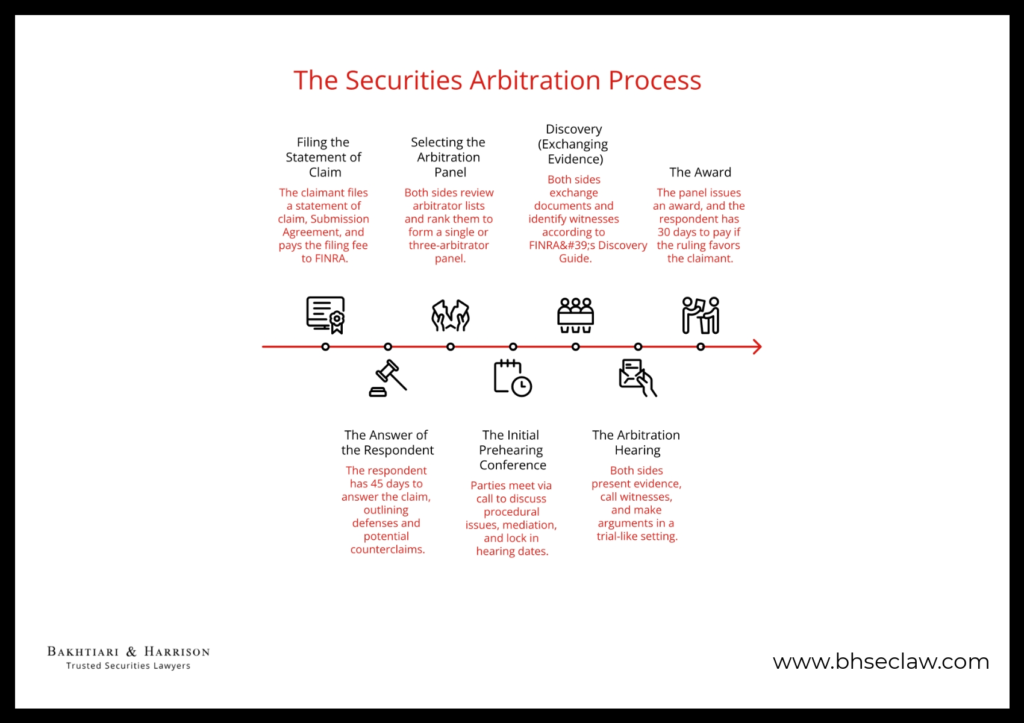
Stage 5: Discovery (Exchanging Evidence)
Both sides exchange documents and identify witnesses. Discovery in arbitration is narrower than in court litigation. Depositions are strongly discouraged and are permitted only in limited circumstances, usually with panel approval. FINRA’s Discovery Guide spells out which documents are presumptively exchanged in customer cases, depending on the type of dispute.
Stage 6: The Arbitration Hearing
This is the closest thing to a trial in the whole process. Both sides present evidence, call witnesses, and make opening and closing arguments. Hearings can happen in person, by video, or over the phone. The arbitrators swear in witnesses, and either side can cross-examine and object to evidence as it comes in. FINRA generally makes the official recording. A party may seek permission for a stenographer or transcript, usually at that party’s expense.
Stage 7: The Award
The panel generally must endeavor to issue the award within 30 business days after the record is closed. If the panel rules in your favor, the firm or broker generally has 30 days to pay. A FINRA member firm or associated person that fails to comply with an award may face FINRA suspension, subject to the applicable rules and any valid court challenge.
Who usually wins in FINRA arbitration?
There’s no guaranteed winner, but FINRA reports that 84% of customer cases closed in 2024 through a settlement or a paid award, which suggests investors with solid claims regularly see a financial outcome.
What Does Securities Arbitration Cost?
Most people ask about the filing fee and stop there. That’s only part of the picture. Here’s what actually shows up on the cost side of a case:
- Initial filing fee. Paid when you file your statement of claim. FINRA may partially refund the filing fee if the claim is settled or withdrawn more than 10 calendar days before the scheduled hearing, less applicable fees and costs.
- Hearing session fees. Charged for each hearing session, including prehearing conferences, not just the final hearing.
- Member surcharges and process fees. These are charged to the brokerage firm, not you, but they factor into how firms evaluate settlement.
- Discovery motion and adjournment fees. If either side asks the panel to rule on a discovery dispute or postpone a hearing, that can trigger an additional fee.
- Attorney fees. Most investor-side securities attorneys, including our firm, work on contingency. That means no upfront cost to you, and the firm only gets paid out of what’s recovered.
FINRA offers a free fee calculator to estimate initial filing costs, and financial hardship waivers are available if paying up front would be a real burden.
Can You Appeal a FINRA Arbitration Award?
Not really, and this catches a lot of people off guard. There’s no internal appeals process at FINRA. Once the panel issues an award, it’s final and binding.
A party may ask a court to vacate, modify, or correct an award, usually within three months under the Federal Arbitration Act, subject to the governing law and limited statutory grounds such as corruption, evident partiality, misconduct, or exceeding the arbitrators’ powers.
That’s exactly why the earlier stages matter so much. You don’t get a second bite at the apple once the hearing is over, which means the statement of claim, discovery, and the hearing itself need to be handled right the first time.
What Are Your Realistic Chances of Recovery?
Nobody can promise you a specific outcome, and any attorney who does should raise a red flag. But the data gives a useful baseline. FINRA reports that 84% of customer arbitration cases closed in 2024 through a settlement or a paid damages award. That doesn’t mean every investor gets everything they asked for. Settlements often involve compromise on both sides, and hearings can go either way depending on the strength of the evidence.
What it does mean is that arbitration regularly produces real financial outcomes for investors, not just a coin flip. The strength of your documentation, the clarity of your timeline, and how well your claim maps onto an actual violation (not just a bad investment result) all shape where your case lands.
Pros and Cons of Securities Arbitration
Benefits
- Faster resolution than court litigation, which can drag on for years
- Lower costs overall, since discovery is narrower and the process moves quicker
- Privacy. Your financial dispute isn’t a matter of public record
- Subject-matter familiarity. Arbitrators often have real securities industry experience
Cons
- Extremely limited appeal rights. If you lose, there’s almost no way back
- No jury. Some investors prefer having a jury of peers rather than an arbitration panel
- Perceived industry ties. Some investors worry that arbitrators connected to the financial industry won’t be fully neutral, though FINRA lets customers request an all-public panel for exactly this reason
How an Investment Loss Attorney Helps With Securities Arbitration
You’re allowed to represent yourself in FINRA arbitration. Plenty of people do. But the respondent, meaning the brokerage firm, will almost always show up with experienced counsel, and the process has real procedural traps for anyone who hasn’t been through it before.
An experienced securities attorney handles the parts most investors have never done: drafting a statement of claim that actually holds up, navigating arbitrator selection strategically, managing discovery disputes, and presenting evidence in a way that connects with the panel.
At Bakhtiari & Harrison, our investment loss attorneys handle securities arbitration claims from the eligibility check through the final hearing, and we do it on contingency. If we don’t recover money for you, you don’t owe us a fee.
Our attorneys also represent clients in securities litigation when a claim falls outside arbitration, and in disputes involving broker misconduct, unauthorized trading, and Ponzi schemes. If you believe you’ve been a victim of investment fraud, the sooner you get a second set of eyes on your documents, the more options may remain available to you. Visit our securities arbitration lawyers page for more on how we build and pursue these claims from start to finish.
Ready to Talk to a Securities Arbitration Lawyer?
Bakhtiari & Harrison represents investors nationwide in FINRA arbitration and securities litigation. Free consultation, no obligation. Get in touch today!