You did everything by the book, and your former firm still found a way to make you look bad on paper. A Form U5 filled with vague, damaging language now sits on your BrokerCheck profile, and it has nothing to do with a customer complaint. That is precisely the type of issue intra-industry expungement is designed to address, though outcomes depend heavily on the specific facts and evidence in your case.
Facing a defamatory complaint from a fellow registered person or your own firm?
Bakhtiari & Harrison offers free, confidential consultations. We’ll tell you whether your case meets the “defamatory in nature” standard, what it’ll cost, and what we think your chances are — before you commit to anything.
What Is Intra-Industry Expungement?
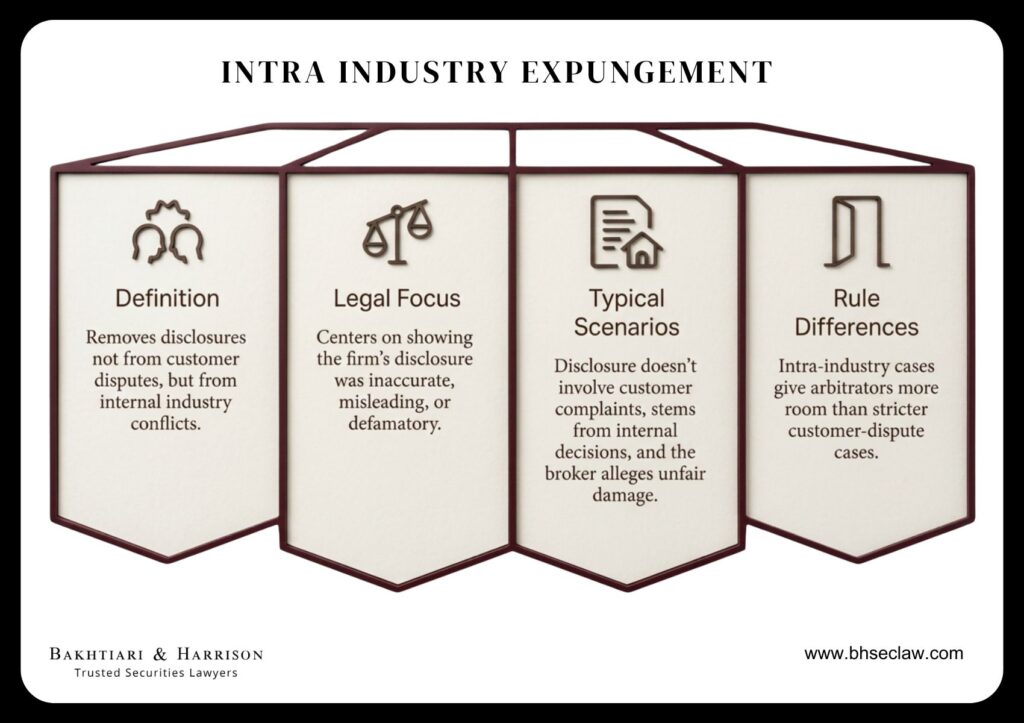
Intra-industry expungement removes a disclosure from the CRD system that did not come from a customer dispute. Instead, it originates from a conflict solely between parties inside the securities industry, typically a registered representative and the firm that employed them. FINRA’s own arbitrator training materials describe these as disputes “between securities firms and their current or former brokers,” governed by a different rulebook than a customer complaint.
The legal fight in these cases does not center on disproving a customer’s claim. It centers on showing that your former firm’s own stated reason for termination or other internal disclosure was inaccurate, misleading, made in bad faith, or defamatory in nature. We have represented brokers where the firm was the only adverse party in the room, and that changes the entire strategy.
In practice, intra-industry expungement claims typically arise where:
- The disclosure does not involve a customer complaint or arbitration filed by an investor
- The language stems from an internal firm decision (for example, a termination, reassignment, or disciplinary finding)
- The broker alleges that the firm’s description is unfairly damaging, inaccurate, or otherwise improper, and asks the panel to order it removed or corrected
Customer-dispute cases follow a stricter path. They are governed by Rule 2080’s narrow customer-dispute standard, which generally requires specific findings, such as that a claim was factually impossible or clearly erroneous, that the associated person was not involved in the alleged misconduct, or that the allegations were false, before a court will typically confirm an expungement award. Intra-industry cases give arbitrators more room to evaluate the fairness and accuracy of a firm’s internal disclosure rather than forcing the case into Rule 2080’s narrow customer‑dispute box.
What is FINRA expungement?
FINRA expungement is the formal process of removing a disclosure from a broker’s CRD record and public BrokerCheck profile. For intra-industry cases, that means a panel finding that a former firm’s termination language was defamatory, inaccurate, or improperly disclosed.
Why this matters with Bakhtiari & Harrison: Ryan Bakhtiari chaired FINRA’s National Arbitration and Mediation Committee, the body that helped shape the arbitration rules now governing your case. That perspective shapes how we build an intra-industry claim from the first filing.(FINRA does not endorse any law firm or outcome, and prior committee service does not guarantee results.)
Schedule a confidential case review →
How a U5 Disclosure Becomes a BrokerCheck Expungement Case
FINRA BrokerCheck is the public window into a broker’s history. Behind it sits the CRD, a more detailed database that firms and regulators can access directly. Information that lands on Form U5, the termination notice every firm must file within 30 days of a registered person’s departure, is what ultimately populates that public report.
Not every U5 disclosure reflects investor harm. In our experience, many trace back to causes that have nothing to do with a client account:
- Firm policy violations,such as using an unapproved communication channel or missing a training deadline, with no customer impact
- Management disagreementsthat get reframed by legal and compliance as a policy issue
- Defensive separations,where a firm protects itself with cautious, broad language rather than a neutral explanation
- Retaliationfollowing a compliance complaint or whistleblower report
Firms have a genuine obligation to report certain events on Form U5, and many err on the side of over-disclosure. But that duty does not authorize them to publish statements that are false, misleading, or made in bad faith. The standard reporting fields do not distinguish a minor internal dispute from a serious regulatory matter. That gap is exactly where a public record ends up implying far more than what actually happened, and it is the gap we spend most of our time arguing in front of arbitrators. We have also seen the four U5 termination categories applied in ways that quietly inflate how serious a departure looks on paper.
Defining the “Defamatory in Nature” Standard
The biggest tactical advantage in an intra-industry dispute is a finding that a firm’s statement is “defamatory in nature.” This specialized regulatory standard works differently from a defamation lawsuit you would bring in state or federal court.
In a FINRA arbitration, you are not required to prove every element of a traditional civil defamation claim (such as actual malice or a specific dollar amount of damages) in the same way you would in court. Instead, the panel is focused on whether the language is inaccurate, misleading, unfairly damaging, or lacking a sufficient factual basis to remain on a permanent regulatory and public record.
Firms that stick to objective, verifiable facts when filing a U5 are often harder to challenge. Brokers tend to have a stronger case when a firm reaches for broad, subjective, or inflammatory language without documentation behind it. Historically, researchers studying thousands of FINRA expungement requests found that roughly 70 to 75% of cases ended in a grant, though the rules have since tightened considerably, and no outcome is ever guaranteed in an individual case.
Common Scenarios That Lead to a Form U5 Expungement Claim
Most intra-industry expungement cases fall into a handful of recurring patterns:
- Wrongful terminationwhere a firm files a U5 with exaggerated or pretextual claims to justify the decision
- U5 defamation, where harsh or inaccurate language is used punitively, sometimes to discourage clients from following a departing broker
- Misinterpreted internal policywhere a minor, good-faith violation gets reported in language that implies serious misconduct
- Retaliation tied to a broker raising compliance concerns before being let go
Each of these scenarios turns on facts, documents, and credibility. Arbitrators do not expunge merely because a termination was contentious. They do so, if at all, when the evidence supports a finding that the disclosure itself should not remain in its current form.
Can FINRA see expunged records?
In limited circumstances, yes. FINRA can retain access to historical disclosure information internally even after it disappears from public BrokerCheck, and may review it as part of a later regulatory inquiry.
FINRA Expungement Rules for 2026
The procedural landscape shifted significantly in late 2023 and again in early 2026. These reforms affect who hears certain expungement cases, how long you have to bring them, and how often expungement is granted, particularly in customer-related “straight-in” cases. Standalone expungement filings dropped by about 79% in the year after the October 2023 reforms, according to FINRA data reported by AdvisorHub, a strong indication that many of the “easy” expungement filings of prior years are no longer being brought at all. That decline underscores how much more carefully panels and practitioners are treating the remedy today.
The most dramatic procedural shifts have involved customer-related expungement of dispute information, for example, “straight-in” requests filed after the underlying customer case has closed. In that arena, recent rule changes have:
- Required that many straight-in requests be heard by a three-person panel of public, chair-qualified arbitrators from a Special Arbitrator Roster with enhanced expungement training
- Mandated unanimous decisions to grant expungement relief in those cases
- Tightened time limits on when expungement can be sought and expanded notice to state regulators and, in some instances, to customers
Intra-industry U5 disputes are still brought under the Industry Code. They do not follow Rule 2080’s customer-dispute standards, and they are not always subject to the Special Arbitrator Roster framework. However, they are being decided in a climate where expungement is viewed as an extraordinary remedy, and panels are increasingly sensitive to the public-record implications of their awards.
Because timing rules and limitation periods can be complex, especially when FINRA rules overlap with applicable state-law deadlines, assessing the calendar is often one of the first steps in an intra-industry strategy session.
Why a Defamatory Finding Is So Valuable for Advisors
In a typical customer-dispute expungement, a broker must obtain a court order confirming the arbitration award before FINRA will act to remove customer complaint information. Rule 2080 expressly ties expungement of customer dispute information to a court process in most situations.
In many intra-industry cases involving Form U5 language, the mechanics are different. If an arbitration panel makes an express finding that a disclosure is defamatory in nature and provides precise replacement language, FINRA can, in appropriate circumstances, process the expungement administratively without a separate court proceeding. FINRA still reviews every award to ensure that it complies with its rules and policies, and it is not obligated to implement an award that does not meet those standards.
For the right case, this can mean a faster and less expensive path to a cleaner record. But that outcome is never automatic: it depends on the panel’s specific findings, the clarity of the award, and FINRA’s independent review.
The Special Arbitrator Roster (Customer-Related Straight-In Requests)
One of the most significant recent enhancements, primarily affecting customer-related expungement, is the use of a Special Arbitrator Roster for “straight-in” requests, meaning cases filed independently after the underlying customer matter has closed.
Under the revised framework for these customer-related requests:
- The arbitration must be heard by a three-person panel of public, chair-qualified arbitrators with enhanced expungement training
- The panel must reach a unanimous decision to grant expungement
- State regulators receive notice and an opportunity to participate, and customers may also receive notice in many cases
These requirements reflect FINRA’s broader effort to make expungement of customer dispute information more consistent and more carefully scrutinized. While intra-industry U5 disputes follow a different track under the Industry Code, they are still influenced by this more conservative view of expungement overall.
Replacement Language Is Required, Not Optional
FINRA cannot simply leave a blank field on the CRD. When an arbitration panel orders a U5 disclosure expunged or modified, the award is expected to specify exactly what should appear in its place.
If your termination reason is “Discharged” or “Permitted to Resign” and a panel finds the firm’s narrative defamatory or inaccurate, the award should say what the new category and explanation will be. In some cases, the cleanest outcome is an award that changes the termination category to “Voluntary” and removes the need for a narrative explanation entirely. That is not always possible or appropriate, and panels are not required to grant that relief.
An award that is too vague, too broad, or inconsistent with the record risks rejection or modification by FINRA’s Registration and Disclosure department. Precision in the requested relief and in the panel’s wording is critical.
The FINRA Expungement Procedure, Step by Step
Securing an intra-industry expungement means initiating a formal FINRA arbitration against your former firm. The process generally follows five stages.
- File the Statement of Claim.This document identifies the defamatory or inaccurate U5 language, states the legal grounds, commonly including defamation, tortious interference, or breach of contract, and specifies that you are seeking expungement.
- Select arbitrators.Both sides review FINRA’s roster, strike candidates, and rank the rest. A single arbitrator or a three-person panel will hear the case, depending on its size.
- Gather evidence.Unlike a customer dispute, intra-industry evidence centers on internal communications, performance reviews, witness accounts from former colleagues, and firm policy manuals showing inconsistent application.
- Attend the hearing.You will testify, and your attorney will present evidence and cross-examine the firm’s witnesses. The goal is a clear, fact-based narrative that systematically replaces the firm’s version of events.
- Receive the award.A favorable award must contain a specific finding that the disclosure was inaccurate, defamatory, or erroneous, along with the necessary replacement language.
Building your case starts before you ever file. The strongest evidence in these matters is often created long before a dispute arises. Saving positive performance reviews and keeping a personal record of compliance concerns you raised can become decisive if a termination turns contentious.
What is the six-year eligibility rule for FINRA expungement?
Under FINRA Rule 12206, an associated person generally has up to six years from the date a disclosure first appeared on their CRD record to bring an expungement claim. Waiting longer can make it harder to gather evidence and weaken your position.
Clear Your CRD Record: How Bakhtiari & Harrison Builds Your Case
Choosing the right legal representation is the most important decision in an expungement case. We concentrate on the FINRA arbitration forum and the specific needs of financial professionals, and that focus shows up in how a case gets built.
- Experience.Our partners have decades of experience navigating FINRA’s Industry Code and the nuances of intra-industry disputes.
- Strategy.We focus on identifying the specific defamatory triggers that can allow a case to bypass court confirmation.
- Track record.We have represented advisors nationwide in disputes over termination language and BrokerCheck disclosures.
Your CRD record is your professional resume. Contact Bakhtiari & Harrison for a confidential consultation, and we will walk through what a realistic path to clearing your name actually looks like in your situation.