Your former firm won’t return your calls. Or worse, they’re actively fighting your FINRA expungement request. If you’re staring down a customer dispute on your CRD record with no help from the firm that employed you, here’s the answer: yes, you can still win. Firm cooperation can make a case easier, but it is not required under FINRA Rule 12805. Arbitrators may still grant expungement when the firm stays silent, opposes the request, or no longer exists, so long as the record supports one of FINRA’s expungement grounds.
Our FINRA expungement attorneys handle these cases regularly. A missing witness is rarely why a case falls apart.
Yes, You Can Win FINRA Expungement Without Firm Support
Nothing in FINRA’s expungement rules conditions relief on your former firm showing up to help you. The text of Rule 12805 lays out what an associated person must do to request expungement of customer dispute information, and FINRA’s own overview of the expungement process confirms the same thing. Firm testimony isn’t on that list. For background on how the underlying disclosure framework works, see our guide to FINRA Rule 2080 and BrokerCheck expungement.
What Rule 12805 Actually Requires
An associated person requesting expungement must include the request in the answer or a separate pleading, generally filed at least 60 days before the first scheduled hearing session. The arbitrator or panel then holds a hearing, reviews the evidence, and decides whether one of the three grounds for expungement applies to the facts of the case. Rule 12805 does not require a representative of the member firm to testify, submit an affidavit, or appear, although the panel may still consider whatever evidence the firm does provide.
Why Firm Cooperation Helps, But Isn’t Mandatory
A cooperative firm witness can speak to internal records, confirm supervisory notes, and corroborate your version of events in a way that feels efficient to an arbitrator. That’s real value. It’s just not the only path.
What arbitrators need is enough credible evidence to conclude that one of FINRA’s three expungement grounds is met: the claim is factually impossible or clearly erroneous, you were not involved in the alleged conduct, or the claim is false. Those are the only three grounds for expungement under FINRA Rule 2080, and nothing in that standard depends on who testified.
Firm testimony is one way to build that record. It is not the only path, and in many cases it may not be available. Our breakdown of the current FINRA expungement rules covers each ground in more detail.
Facing a Customer Dispute With No Help From Your Former Firm?
Bakhtiari & Harrison represents financial professionals in FINRA expungement proceedings nationwide, including cases where the former firm is silent, hostile, or defunct. Ryan Bakhtiari chaired FINRA’s National Arbitration and Mediation Committee, the body that wrote the rules governing these proceedings. Consultations are free and confidential.
Pursuing FINRA Expungement Without Employer Cooperation
Most financial professionals assume their former employer needs to back them up. That assumption comes from how expungement is often described online, not from the rule itself. In practice, member firms often sit out straight-in expungement requests because they are not required to present evidence or appear in support of a former associated person.
How This Plays Out in Practice
A firm might decline to send a witness because the employee who handled your account has left. It might decline because its compliance department has a blanket policy against participating in former employees’ arbitrations. Or it might just never respond to outreach at all. None of those situations is unusual, and none of them is fatal to your case, as one stockbroker’s own expungement journey illustrates.
What Arbitrators Weigh Instead
Arbitrators deciding an expungement claim look at the full evidentiary record, not just who showed up to testify. That record can include account documentation, the customer’s trading history, communications from the relevant period, and testimony from witnesses with direct knowledge of the facts, whether or not they still work for the brokerage firm.
Do I need my former firm’s cooperation to win a FINRA expungement?
No. FINRA Rule 12805 doesn’t require firm testimony or participation. Arbitrators decide based on the full evidentiary record, which can include account statements, correspondence, and independent witnesses.
When Your Expungement Former Firm Opposes You
Active opposition is often the most challenging scenario, but it can also help clarify what evidence matters most. A firm that opposes your expungement request usually does so for one of two reasons: it disputes the underlying facts, or it’s protecting itself from a related liability, like a co-respondent status in the original customer arbitration or civil litigation.
Reading Between the Lines of Opposition
Before you treat firm opposition as a roadblock, figure out why it’s happening. If the firm was also named in the customer complaint, its opposition may have nothing to do with the merits of your individual conduct and everything to do with its own exposure. Arbitrators may recognize that distinction when the record and argument are presented clearly, and FINRA’s guidance to arbitrators on expanded expungement review specifically directs panels to evaluate the full record rather than defer to a party’s position.
If you’re earlier in the process and want the full walkthrough, our 5-step guide to CRD expungement covers what to expect before a firm’s posture is even clear.
Turning Opposition Into an Opportunity
A firm that opposes expungement but can’t produce evidence contradicting your account tends to weaken its own position. If the firm’s opposition rests on conclusory statements rather than documents, that gap is worth pointing out directly. Under FINRA Rule 2081, a firm can’t condition settlement of a customer dispute on an agreement not to pursue expungement, which means a firm’s after-the-fact opposition has to stand on its own merits, not on pressure built into a prior settlement.
How long does an expungement case take without firm testimony?
Timeline is driven more by FINRA’s hearing calendar and court confirmation process than by firm participation. Most expungement matters run 9 to 18 months from filing through CRD removal, with or without a cooperating firm witness.
The Other Two Scenarios: Neutral and Unavailable Firms
When the Firm Stays Neutral
A neutral firm is the most common scenario we see. The firm doesn’t object, doesn’t help, and doesn’t send anyone to the hearing. This is often just a resourcing decision on the firm’s part rather than a comment on your case, and it’s the easiest of the three scenarios to work around with independent evidence.
When the Firm No Longer Exists
Broker-dealers merge, get acquired, or shut down. If your former firm is no longer in business, there’s simply no one left to testify on the firm’s behalf, and arbitrators understand that. What matters is whether you can still produce reliable documentary evidence from the relevant period, even if the firm itself no longer exists.
Can my former firm block my expungement request?
A firm can oppose your request, but opposition alone doesn’t defeat it. Arbitrators weigh the firm’s position against the documentary and testimonial evidence you present, not the firm’s willingness to help.
Building an Independent Expungement Evidence Strategy
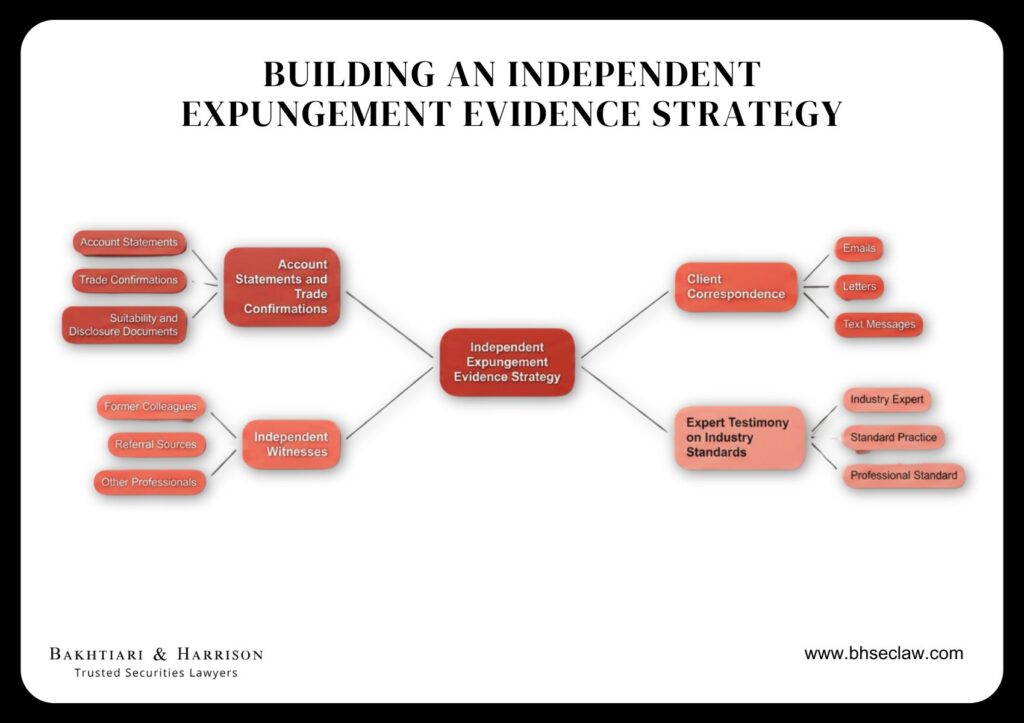
An independent expungement evidence strategy means building your case around documents and witnesses that don’t depend on your former firm showing up. Done well, it can be just as persuasive to an arbitration panel as firm testimony because it isn’t coming from a party with its own interests in the outcome.
Account Statements and Trade Confirmations
Your client’s own account statements and trade confirmations are often the single strongest piece of independent evidence available. They show what was actually bought, sold, and disclosed, with a timestamp that can’t be disputed after the fact.
- Account statements establish the actual positions and performance that the customer saw each month.
- Trade confirmations show the specific instructions and timing behind each transaction.
- Suitability and disclosure documents demonstrate what the customer acknowledged reviewing at account opening.
Client Correspondence
Emails, letters, and even text messages between you and the customer can directly contradict a complaint’s version of events. If a client wrote to thank you for a recommendation they’re now disputing, that correspondence carries real weight.
Independent Witnesses
Former colleagues, referral sources, or other professionals who observed the relevant transactions can testify even after leaving the firm. Their independence from your current dispute, and often from the firm itself, can make their account more credible, not less.
Expert Testimony on Industry Standards
An industry expert can explain to the panel what standard practice looked like at the time of the transaction and whether your conduct met it. This is especially useful when a complaint alleges a violation, such as unsuitable recommendations, that depends on judging your conduct against a professional standard rather than a simple factual dispute.
Does FINRA still have access to expunged records?
In limited circumstances, yes. If a broker later becomes the subject of a new investigation, FINRA may review sealed expungement records as part of that inquiry, even though the public no longer has access through BrokerCheck.
FINRA Expungement With No Firm Testimony: What Happens at the Hearing
The absence of firm testimony should be addressed directly in your hearing presentation, not left for the panel to notice on its own. Arbitrators appreciate a claimant who acknowledges the gap and explains how the remaining record fills it.
Address the Gap Before the Panel Does
Open your presentation of evidence by briefly explaining why the firm isn’t participating. Whether that’s because the firm is defunct, has declined to engage, or is actively opposing you, a short, factual explanation removes the question mark before it becomes a distraction. Since 2023, arbitrators deciding these cases must also complete enhanced expungement training before they can hear a request, which means the panel in front of you already understands that firm participation is optional under the rules. For a sense of how each stage fits together, see our FINRA expungement timeline breakdown.
Presenting a Complete Record Without a Cooperating Witness
From there, the goal is a record that stands on its own. Organize your account statements, correspondence, and any independent witness testimony around the specific ground for expungement you’re asserting, whether that’s factual impossibility, non-involvement, or a false claim. A panel is more likely to grant relief when each piece of evidence clearly supports a specific Rule 2080 ground.
Three Real-World Scenarios Financial Professionals Face
You Left the Firm on Bad Terms
A contentious departure, especially one involving a disputed Form U5, often means the firm has little incentive to help you clear your record. If your termination language itself is part of what you’re disputing, our U5 defamation team frequently handles both issues together, since the same underlying facts often support both claims. If your departure also triggered a FINRA inquiry, our guide to responding to a Rule 8210 request covers how that process interacts with an expungement filing.
The Firm Is Named in the Complaint Itself
When the customer complaint names the firm alongside you, the firm has its own legal exposure to manage. Its silence, or its opposition, is often driven by its own defense strategy rather than any judgment about your individual conduct. Separating your evidence from the firm’s litigation posture is critical here.
The Firm Is No Longer in Business
Firms fold, get absorbed into larger broker-dealers, or lose their FINRA membership entirely. None of that erases the underlying documentation from your time there. Account records, correspondence, and your own case file typically survive even when the firm doesn’t.
Your Former Firm’s Silence Doesn’t Have to Be the Last Word: Talk to Us
A missing or hostile former employer is a challenge, not a dead end. We’ve built expungement cases from account records, correspondence, and independent testimony for financial professionals whose firms never showed up, and we know how to present that record so a panel takes it seriously.
Ryan Bakhtiari chaired FINRA’s National Arbitration and Mediation Committee, the body that wrote the rules governing expungement proceedings. Partner David Harrison has won significant U4/U5 expungement cases, including against Merrill Lynch, Pierce, Fenner & Smith.
If your former firm will not help or will not stop fighting you, contact us for a free, confidential consultation with a FINRA expungement attorney who has handled cases exactly like yours.